MCQ
When $KMnO_4$ solution is added to hot oxalic acid solution, the decolourisation is slow in the beginning but becomes instantaneous after some time. This is because
  • $Mn^{2+}$ acts as auto catalyst
  • B
    $CO_2$ is formed
  • C
    Reaction is exothermic
  • D
    $MnO_4^-$ catalyses the reaction.

Answer

Correct option: A.
$Mn^{2+}$ acts as auto catalyst
a
Here, $KMnO _4$ is a reactant in the reaction which forms $Mn ^{2+}$ which acts as an auto-catalyst. The reaction is slow initially because $MnO _4{ }^{-}$is getting converted to $Mn ^{2+}$ but once $Mn ^{2+}$ forms, the reaction becomes faster due to the catalytic action.

Need a full question paper?

Generate a complete, print-ready paper with questions like this in minutes — across 16+ boards, with answer keys.

Start Generating Free

Similar questions

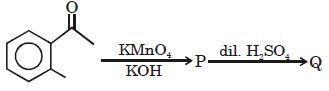
Major product $(Q)$ of following reaction is used to form :
The following data is given for reaction between $A$ and $B$

$S.NO.$  $[A]$    $mol.L^{-1}$  $[B]$    $mol.L^{-1}$ $Rate$    $mol.L^{-1}\,sec^{-1}$
$I$ $1 \times 10^{-2}$ $2 \times 10^{-2}$ $2 \times 10^{-4}$
$II$ $2 \times 10^{-2}$ $2 \times 10^{-2}$ $4 \times 10^{-4}$
$III$ $2 \times 10^{-2}$ $4 \times 10^{-2}$ $8 \times 10^{-4}$ 

  Which of the following are correct statements -

$(a)$  Rate constant of the reaction $10^{-4}$

$(b)$  Rate law of the reaction is $k[A][B]$

$(c)$  Rate of reaction increases four times on doubling the concentration of both the reactant

The binding of oxygen by haemoglobin $(Hb)$ forming $(HbO_2)$, is partially regulated by the concentration of $H_3O^+$ and dissolved $CO_2$ in blood.

$Hb{O_2} + {H_3}{O^ + }C{O_2} \rightleftharpoons \left( {{H^ + } - Hb - C{O_2}} \right) + {O_2} + {H_2}O$

Release of $O_2$ is favoured when there is

Which of the following conversions involves change in both shape and hybridisation?
From the following ${E^o}$ values of half cells, what combination of two half cells would result in a cell with the largest potential ?

$\left( I \right)A + {e^ - } \to {A^\circleddash  }\,\,\,\,\,\,{E^o} =  + 0.24\,V$

$\left( {II} \right){B^ - } + {e^ - } \to {B^{ - 2}}\,\,\,\,\,\,{E^o} =  + 1.25\,V$

$\left( {III} \right){C^ - } + 2{e^ - } \to {C^{ - 3}}\,\,\,\,\,\,{E^o} =  + 0.15\,V$

$\left( {IV} \right)D + 2{e^ - } \to {D^{ - 2}}\,\,\,\,\,\,{E^o} =  + 0.68\,V$

Which of the following compound will not dissolve in hot mixture of $NaOH$ and $H_2O$ ?
Two oxides of nitrogen, $NO$ and $NO_2$ are allowed to react together at $243\,^o K$ and form a coloured compound of nitrogen $(X)$ . When compound $(X)$ reacts with water to yield another compound of nitrogen $(Y)$. The shape of the anion of $(Y)$ molecule is
Molal depression constant for water is ${1.86\,^o}C$. The freezing point of a $0.05\,molal$ solution of a non-electrolyte in water is
Which carbonyl compound has maximum dipole moment
When $KMnO_4$ solution is added to hot oxalic acid solution, the decolourisation is slow in the beginning but becomes instantaneous after sometime. This is because