MCQ
When light is refracted into a medium:
  • A
    Its wavelength and frequency both increase
  • B
    Its wavelength increases but frequency remains unchanged
  • C
    Its wavelength decreases but frequency remains unchanged.
  • D
    Its wavelength and frequency both decrease.
Answer

  1. Its wavelength decreases but frequency remains unchanged.

Explanation:

Frequency of a light wave, as it travels from one medium to another, always remains unchanged, while wavelength decreases.

Decrease in the wavelength of light entering a medium of refractive index $\mu$, is given by,

$\lambda_\text{M}=\frac{\lambda}{\mu},$

Where $\lambda_\text{M}$ = wavelength in medium

$\lambda$ = wavelength in vacuum

$\mu$ = refractive index

Need a full question paper?

Generate a complete, print-ready paper with questions like this in minutes — across 16+ boards, with answer keys.

Start Generating Free

Similar questions

The centre of a wheel rolling on a plane surface moves with a speed v0. A particle on the rim of the wheel at the same level as the centre will be moving at speed:

  1. $\text{Zero.}$

  2. $\text{v}_0$

  3. $\sqrt2\text{v}_0$

  4. $2\text{v}_0$

An energy of 24.6 eV is required to remove one of the electrons from a neutral helium atom. The energy (in eV) required to remove both the electrons from a neutral helium atom is

(a) 79.0

 (b) 51.8

(c) 49.2   

(d) 38.2

An electron moving to the east in a horizontal plane is deflected towards south by a magnetic field. The direction of this magnetic field is:

What should be the angle between two plane mirrors so that whatever be the angle of incidence, the incident ray and the reflected ray from the two mirrors be parallel to each other

(a) 60°

(b) 90°

(c) 120°

(d) 175°

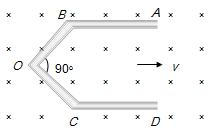
A conductor ABOCD moves along its bisector with a velocity of 1 m/s through a perpendicular magnetic field of 1 wb/m2, as shown in fig. If all the four sides are of 1m length each, then the induced emf between points A and D is

(a) 0

(b) 1.41 volt

(c) 0.71 volt

(d) None of the above

A stream of electrons is projected horizontally to the right. A straight conductor carrying a current is supported parallel to electron stream and above it. If the current in the conductor is from left to right then what will be the effect on electron stream 

(a) The electron stream will be pulled upward

(b) The electron stream will be pulled downward

(c) The electron stream will be retarted

(d) The electron beam will be speeded up towards the right

A nucleus of atomic mass A and atomic number Z emits β - particles. The atomic mass and atomic number of the resulting nucleus are

(a) A, Z

(b) A + 1, Z

(c) A, Z + 1

(d) A – 4, Z - 2

Variation of current passing through a conductor as the voltage applied across its ends as varied is shown in the adjoining diagram. If the resistance (R) is determined at the points A, B, C and D, we will find that

(a) RC = RD

(b) RB > RA

(c) RC > RB

(d) None of these

Immiscible transparent liquids A, B, C, D and E are placed in a rectangular container of glass with the liquids making layers according to their densities. The refractive index of the liquids are shown in the adjoining diagram. The container is illuminated from the side and a small piece of glass having refractive index 1.61 is gently dropped into the liquid layer. The glass piece as it descends downwards will not be visible in

(a) Liquid A and B only

(b) Liquid C only

(c) Liquid D and E only

(d) Liquid A, B, D and E

According to corpuscular theory of light, the different colours of light are due to

(a) Different electromagnetic waves

(b) Different force of attraction among the corpuscles

(c) Different size of the corpuscles

(d) None of the above