MCQ
When red glass is heated in dark room it will seem
  • Green
  • B
    Purple
  • C
    Black
  • D
    Yellow

Answer

Correct option: A.
Green
a
(a) Red and green colours are complementary to each other.

When red glass is heated it absorbs green light strongly, hence according to Kirchoff’s law, the emissive power of red glass should be maximum for green light.

That’s why when this heated red glass is taken in dark room it strongly emits green light and looks greenish.

Need a full question paper?

Generate a complete, print-ready paper with questions like this in minutes — across 16+ boards, with answer keys.
Start Generating Free

Similar questions

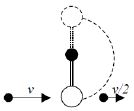
A bullet of mass $m$ and speed $v$ hits a pendulum bob of mass $M$ at time $t_1$, and passes completelythrough the bob. The bullet emerges at time $t_2$ with a speed of $v/2$. The pendulum bob is suspended by a stiff rod of length $l$ and negligible mass. After the collision, the bob can barely swing through a complete vertical circle.At time $t_3$, the bob reaches the highest position.What quantities are conserved in this process?
Two metal spheres of capacitances C1 and C2 carry some charges. They are put in contact and then separated. The final charges Q1 and Q2 on them will satisfy:

  1. $\frac{\text{Q}_1}{\text{Q}_2}<\frac{\text{C}_1}{\text{C}_2}$

  2. $\frac{\text{Q}_1}{\text{Q}_2}=\frac{\text{C}_1}{\text{C}_2}$

  3. $\frac{\text{Q}_1}{\text{Q}_2}>\frac{\text{C}_1}{\text{C}_2}$

  4. $\frac{\text{Q}_1}{\text{Q}_2}=\frac{\text{C}_2}{\text{C}_1}$

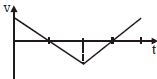
The graph below shows the velocity versus time graph for a body.

Which of the following graphs represents the corresponding acceleration $v/s$ time graph ?
A projectile projected at an angle ${30^o}$ from the horizontal has a range $2\upsilon ,\,\sqrt 2 \upsilon \,\,{\rm{ and}}\,{\rm{zero}}$. If the angle of projection at the same initial velocity be ${60^o}$, then the range will be
A body starts from rest with uniform acceleration $a,$  its velocity after $n\,seconds$ is $v$. The displacement of the body in last $3\,s$ is : (assume total time of journey from $0$ to $n\,seconds$ )
Two gases occupy two containers $A$ and $B$ the gas in $A$, of volume $0.10\,m ^3$, exerts a pressure of $1.40\,MPa$ and that in $B$ of volume $0.15 m ^3$ exerts a pressure $0.7\,MPa$. The two containers are united by a tube of negligible volume and the gases are allowed to intermingle. Then if the temperature remains constant, the final pressure in the container will be (in MPa)
By doubling the amplitude of a simple pendulum, the maximum value of its swing will be how many times ?
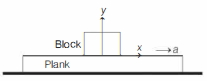
A plank is moving in a horizontal direction with a constant acceleration $\alpha \hat{ i }$. A uniform rough cubical block of side $l$ rests on the plank and is at rest relative to the plank. Let the centre of mass of the block be at $(0, l / 2)$ at a given instant. If $\alpha =g / 10$, then the normal reaction exerted by the plank on the block at that instant acts at
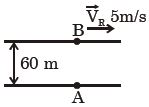
A man is crossing a river flowing with velocity of $5\, m/s$. He reaches a point directly across at a distance of $60\, m$ in $5\, sec$. His velocity in still water should be........$m/s$
A stone of mass $m$, tied to the end of a string , is whirled around in a circle on a horizontal frictionless table. The length of the string is reduced gradually keeping the angular momentum of the stone about the centre of the circle constant. Then , the tension in the string is given by $T\, = Ar^n$, where $A$ is a constant, $r$ is the instantaneous radius of the circle. The value of $n$ is equal to