MCQ
When subjected to a transverse electric field, cathode rays move
  • A
    Down the potential gradient
  • Up the potential gradient
  • C
    Along a hyperbolic path
  • D
    Along a circular path

Answer

Correct option: B.
Up the potential gradient
b
(b)In an electric field, a force opposite to the direction of electric field acts on negatively charged particles (i.e. from lower potential to higher potential).

Need a full question paper?

Generate a complete, print-ready paper with questions like this in minutes — across 16+ boards, with answer keys.
Start Generating Free

Similar questions

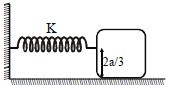
Find maximum amplitude for safe $SHM$ (block does not topple during $SHM$) of $a$ cubical block of side $'a'$ on a smooth horizontal floor as shown in figure (spring is massless)
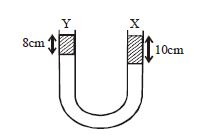
A liquid $X$ of density $3.36\  g/cm^3$ is poured in a $U-$ tube, which contains $Hg$. Another liquid $Y$ is poured in left arm with height $8\  cm$, upper levels of $X$ and $Y$ are same. What is density of $Y$ .......... $g/cc$
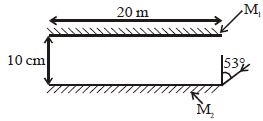
Two plane mirrors $M_1$ and $M_2$ have a length of $20\,m$ each and are $10\,cm$ apart. A ray of light is incident on one end of mirror $M_2$ at an angle of $53^o$. The number of reflections light undergoes before reaching the other end is
A small bulb is placed at the bottom of a tank containing water to a depth of $80\, cm$. What is the area of the surface of water through which light from the bulb can emerge out Refractive index of water is $1.33$.......$m^2$ (Consider the bulb to be a point source.)
In intrinsic semiconductor at room temperature, number of electrons and holes are
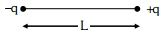
Two point charges $-q$ and $+q$ are placed at a distance of $L$, as shown in the figure.

The magnitude of electric field intensity at a distance $R ( R \gg L )$ varies as :
If $Y, K$ and $\eta$ are the values of Young's modulus, bulk modulus and modulus of rigidity of any material respectively. Choose the correct relation for these parameters.
Two coherent sources $S_1$ and $S_2$ are separated by a distance four times the wavelength $\lambda$ of the source. The sources lie along y axis whereas a detector moves along $+ x$ axis. Leaving the origin and far off points the number of points where maxima are observed is
Equations ${y_1} = A\sin \omega t$ and ${y_2} = \frac{A}{2}\sin \omega t + \frac{A}{2}\cos \omega t$ represent $S.H.M.$ The ratio of the amplitudes of the two motions is
Two stones are thrown up simultaneously with initial speeds of ' $u_1$ and $u_2\left(u_2 > u_1\right)$. They hit the ground after $6\,s$ and $10\,s$ respectively. Which graph in figure correctly represents the time variation of $\Delta x=\left(x_2-x_1\right)$, the relative position of the second stone with respect to the first upto $t=10\,s$ ? Assume that the stones do not rebound after hitting the ground.