MCQ
When subjected to a transverse electric field, cathode rays move
  • A
    Down the potential gradient
  • Up the potential gradient
  • C
    Along a hyperbolic path
  • D
    Along a circular path

Answer

Correct option: B.
Up the potential gradient
In an electric field, a force opposite to the direction of electric field acts on negatively charged particles (i.e. from lower potential to higher potential).

Need a full question paper?

Generate a complete, print-ready paper with questions like this in minutes — across 16+ boards, with answer keys.
Start Generating Free

Similar questions

Equation of motion in the same direction is given by $y_1=A \sin (\omega t-k x), y_2=A \sin (\omega t-k x-\theta)$. The amplitude of the medium particle will be
When a resistor of $1 \Omega$ is connected in series with an electric cell, the current flowing in it is $0.5 \mathrm{~A}$. Instead, when a resistor of $5 \Omega$ is connected to the same electric cell in series, the current increases by $0.4 \mathrm{~A}$. The internal resistance of the cell is
In a step up transformer, $220 V$ is converted into $200 V$. The number of turns in primary coil is $600.$ What is the number of turns in the secondary coil
A vector $\vec{A}$ points vertically upward and $\vec{B}$ points towards north. The vector product $\vec{A} \times \vec{B}$ is
The Young's modulus of a rubber string $8 cm$ long and density $1.5 kg / m ^3$ is $5 \times 10^8 N / m ^2$, is suspended on the ceiling in a room. The increase in length due to its own weight will be
Three observers $A, B$ and $C$ measure the speed of light coming from a source to be $v_A, v_B$ and $v_C$. The observer $A$ moves towards the source, the observer $C$ moves away from the source with the same speed. The observer $B$ stays stationary. the surrounding space is vacuum every where. Then
particle is dropped from a height and another particle is thrown in horizontal direction with speed of $5 m / sec$ from the same height. The correct statement is
A mercury drop of $1 \mathrm{~cm}$ radius is broken into $10^6$ small drops. The energy used will be (surface tension of mercury is $\left.35 \times 10^{-3} \mathrm{~N} / \mathrm{cm}\right)$
Conductivity increases in the order of
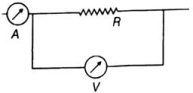
In the adjoining circuit diagram, the readings of ammeter and voltmeter are $2\, A$ and $120 \,V$, respectively. If the value of $R$ is $75\, \Omega$, then the voltmeter resistance will be $\Omega$