MCQ
When the distance between the charged particles is halved, the force between them becomes
  • A
    One-fourth
  • B
    Half
  • C
    Double
  • Four times

Answer

Correct option: D.
Four times
d
(d)$F \propto \frac{1}{{{r^2}}}$; so when $r$ is halved the force becomes four times.

Need a full question paper?

Generate a complete, print-ready paper with questions like this in minutes — across 16+ boards, with answer keys.

Start Generating Free

Similar questions

If an ideal gas is compressed isothermally then
If the magnetic field in a plane electromagnetic wave is given by

$\overrightarrow{\mathrm{B}}=3 \times 10^{-8} \sin \left(1.6 \times 10^{3} \mathrm{x}+48 \times 10^{10} \mathrm{t}\right) \hat{\mathrm{j}}\; \mathrm{T}$

then what will be expression for electric field?
A man is slipping on a frictionless inclined plane and a bag falls down from the same height. Then the velocity of both is related as
What should be the maximum acceptance angle at the air-core interface of an optical  fibre if $n_1$ and $n_2$ are the refractive indices of the core and the cladding  respectively
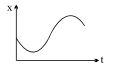
The graph of position $x$ versus time $t$ represents the motion of a particle. If $b$ and $c$ are both positive constants, which of the following expressions best describes the acceleration $a$ of the particle?
A loop of flexible wire of irregular shape carrying current is placed in an external magnetic field. Identify the effect of the field on the wire.
A wire can be broken by applying a load of $200\, N$. The force required to break another wire of the same length and same material, but double in diameter, is .......... $N$
A person travels along a straight road for the first half time with a velocity ${v_1}$ and the next half time with a velocity ${v_2}$ . The mean velocity $V$ of the man is
A simple pendulum executing $S.H.M.$ is falling freely along with the support. Then
A particle of mass $\mathrm{m}$ is dropped from a height $h$ above the ground. At the same time another particle of the same mass is thrown vertically upwards from the ground with a speed of $\sqrt{2 \mathrm{gh}} .$ If they collide head-on completely inelastically, the time taken for the combined mass to reach the ground, in units of $\sqrt{\frac{\mathrm{h}}{\mathrm{g}}}$ is