When the resistance of $9 \,\Omega$ is connected at the ends of a battery, its potential difference decreases from $40\, volt$ to $30\, volt$. The internal resistance of the battery is ............... $\Omega$
Medium
Download our app for free and get started
The internal resistance of battery is given by
$r = \left( {\frac{E}{V} - 1} \right)R = \left( {\frac{{40}}{{30}} - 1} \right) \times 9$$ = \frac{{9 \times 10}}{{30}} = 3\,\Omega $

Download our appand get started for free
Experience the future of education. Simply download our apps or reach out to us for more information. Let's shape the future of learning together!No signup needed.*
Similar Questions
- 1In a wire of circular cross-section with radius $r$, free electrons travel with a drift velocity $V$ when a current $I$ flows through the wire. What is the current in another wire of half the radius and of the same material when the drift velocity is $2V$View Solution
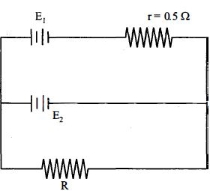
- 2A $dc$ source of $emf \,E_1 = 100\,V$ and internal resistance $r = 0.5\,\Omega ,$ a storage battery of emf $E_2 = 90\,V$ and an external resistance $R$ are connected as shown in figure. For what value of $R$ no current will pass through the battery ? ................ $\Omega$View Solution
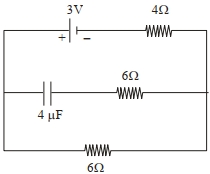
- 3In the network shown below, the charge accumulated in the capacitor in steady state will be ........... $\mu C$View Solution
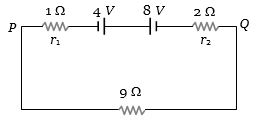
- 4Two batteries of $e.m.f.$ $4\,V$ and $8 \,V$ with internal resistances $1\, \Omega$ and $2\,\Omega$ are connected in a circuit with a resistance of $9 \,\Omega$ as shown in figure. The current and potential difference between the points $P$ and $Q$ areView Solution
- 5View SolutionAccording to Joule's law, if the potential difference across a conductor having a material of specific resistance remains constant, then the heat produced in the conductor is directly proportional to
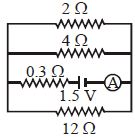
- 6In the circuit shown in the adjoining figure, the reading of ammeter $A$ is ................ $\mathrm{A}$View Solution
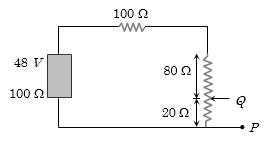
- 7In the circuit, the potential difference across $PQ$ will be nearest to .............. $V$View Solution
- 8View SolutionTwo heater wires of equal length are first connected in series and then in parallel. The ratio of heat produced in the two cases is
- 9The current flowing through a lamp marked as $50\, W$ and $250\, V$ is ............. $amp$View Solution
- 10There are $0.8 \times 10^{23}$ free electrons $/ cm^3$ in copper. If $0.2\, A $ current is flowing is copper wire, then the drift velocity of electrons will be, if the cross sectional area of wire is $0.01 \,cm^2$View Solution