MCQ
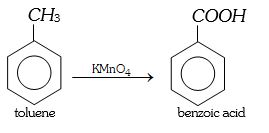
When toluene is treated with $KMn{O_4}$, what is produced
- ABenzene
- BChlorobenzene
- CBenzaldehyde
- ✓Benzoic acid
Generate a complete, print-ready paper with questions like this in minutes — across 16+ boards, with answer keys.

| $column 1$ | $column 2$ | $column 3$ |
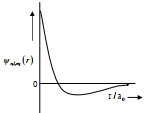
| $(I)$ $1$s orbital | $(i)$ $\psi_{n, l, m_l} \propto\left(\frac{Z}{a_0}\right)^{\frac{3}{2}} e^{-\left(\frac{Z r}{a_0}\right)}$ | $image$ |
| ($II$) $2 \mathrm{~s}$ orbital | $(ii)$ One radial node | $(Q)$ Probability density at nucleus $\propto \frac{1}{a_0^3}$ |
| $(III)$ $2 p_z$ orbital | $(iii)$ $\psi_{n, l m_l} \propto\left(\frac{Z}{a_0}\right)^{\frac{5}{2}} r e^{-\left(\frac{Z r}{2 a_0}\right)} \cos \theta$ | $(R)$ Probability density is maximum at nucleus |
| $(IV)$ $3 \mathrm{~d}_{\mathrm{z}}^2$ orbital | $(iv)$ $x y$-plane is a nodal plane | $(S)$ Energy needed to excite electron from $n=2$ state to $n=4$ state is $\frac{27}{32}$ times the energy needed to excite electron from $n=2$ state to $n=6$ state |
($1$) For the given orbital in Column $1$, the only $CORRECT$ combination for any hydrogen-like species is
$[A] (IV) (iv) (R)$ $[B] (II) (ii) (P)$ $[C] (III) (iii) (P)$ $[D] (I) (ii) (S)$
($2$) For $\mathrm{He}^{+}$ion, the only INCORRECT combination is
$[A] (II) (ii) (Q)$ $[B] (I) (i) (S)$ $[C] (I) (i) (R)$ $[D] (I) (iii) (R)$
($3$) For hydrogen atom, the only $CORRECT$ combination is
$[A] (I) (iv) (R)$ $[B] (I) (i) (P)$ $[C] (II) (i) (Q)$ $[D] (I) (i) (S)$
Give the answer quetion ($1$) ($2$) and ($3$)