MCQ
When two waves of almost equal frequency $n_1$ and $n_2$ are produced simultaneously, then the time interval between successive maxima is:
  • $\frac{1}{\text{n}_1-\text{n}_2}$
  • B
    $\frac{1}{\text{n}_1}-\frac{1}{\text{n}_2}$
  • C
    $\frac{1}{\text{n}_1}+\frac{1}{\text{n}_2}$
  • D
    $\frac{1}{\text{n}_1+\text{n}_2}$

Answer

Correct option: A.
$\frac{1}{\text{n}_1-\text{n}_2}$
Time interval between two successive maxima $=$ time interval between two successive beats
$=\frac{1}{\text{n}}=\frac{1}{\text{n}_1-\text{n}_2}$

Need a full question paper?

Generate a complete, print-ready paper with questions like this in minutes — across 16+ boards, with answer keys.

Start Generating Free

Similar questions

Surface of the lake is at $2^{\circ} C$. The temperature of the bottom of the lake is ....... $^{\circ} C$
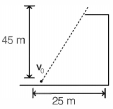
In a circus, a performer throws an apple towards a hoop held at $45 \,m$ height by another performer standing on a high platform (see figure). The thrower aims for the hoop and throws the apple with a speed of $24 \,m / s$. At the exact moment that the thrower releases the apple, the other performer drops the hoop. The hoop falls straight down. At ............ $m$ height above the ground does the apple go through the hoop?
Two capillary tubes of same diameter are put vertically one each in two liquids whose relative densities are $0.8$ and $0.6$ and surface tensions are $60$ and $50\, dyne/cm$ respectively Ratio of heights of liquids in the two tubes $\frac{h_1}{h_2}$ is
The weight of a body at the centre of the earth is
Vectors $a \hat{i}+b \hat{j}+\hat{k}$ and $2 \hat{i}-3 \hat{j}+4 \hat{k}$ are perpendicular to each other when $3 a+2 b=7$, the ratio of a to $b$ is $\frac{x}{2}$. The value of $x$ is $..............$
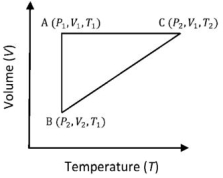
A reversible cyclic process for an ideal gas is shown below. Here, $P, V$, and $T$ are pressure, volume and temperature, respectively. The thermodynamic parameters $q, w, H$ and $U$ are heat, work, enthalpy and internal energy, respectively.

(image)

The correct option ($s$) is (are)

$(A)$ $q_{A C}=\Delta U_{B C}$ and $W_{A B}=P_2\left(V_2-V_1\right)$

$(B)$ $\mathrm{W}_{\mathrm{BC}}=\mathrm{P}_2\left(\mathrm{~V}_2-\mathrm{V}_1\right)$ and $\mathrm{q}_{\mathrm{BC}}=\mathrm{H}_{\mathrm{AC}}$

$(C)$ $\Delta \mathrm{H}_{\mathrm{CA}}<\Delta \mathrm{U}_{\mathrm{CA}}$ and $\mathrm{q}_{\mathrm{AC}}=\Delta \mathrm{U}_{\mathrm{BC}}$

$(D)$ $\mathrm{q}_{\mathrm{BC}}=\Delta \mathrm{H}_{\mathrm{AC}}$ and $\Delta \mathrm{H}_{\mathrm{CA}}>\Delta \mathrm{U}_{\mathrm{CA}}$

Which one of the following is not used to reduce friction
The distance between centre of the earth and moon is $384000\, km$. If the mass of the earth is $6 \times {10^{24}}kg$ and $G = 6.66 \times {10^{ - 11}}\,N{m^2}/k{g^2}$. The speed of the moon is nearly......... $km/sec$
In planetary motion the areal velocity of position vector of a planet depends on angular velocity $(\omega )$ and the distance of the planet from sun $(r)$. If so the correct relation for areal velocity is
The equation $\overrightarrow {\phi \,} (x,\,t) = \overrightarrow {j\,} \sin \,\left( {\frac{{2\pi }}{\lambda }v\,t} \right)\cos \,\left( {\frac{{2\pi }}{\lambda }x} \right)$ represents