MCQ
When water boils or freezes, during these processes its temperature:
  • A
    Increases.
  • B
    Decreases.
  • Does not change.
  • D
    Sometimes increase and sometimes deceases.

Answer

Correct option: C.
Does not change.
When water boils or freezes, its temperature does not change during these processes. Heat here is absorbed or liberated as latent heat.

Need a full question paper?

Generate a complete, print-ready paper with questions like this in minutes — across 16+ boards, with answer keys.

Start Generating Free

Similar questions

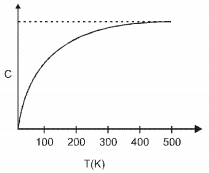
The figure below shows the variation of specific heat capacity $(C)$ of a solid as a function of temperature $(T)$. The temperature is increased continuously from $0$ to $500 \ K$ at a constant rate. Ignoring any volume change, the following statement$(s)$ is (are) correct to a reasonable approximation.$Image$

$(A)$ the rate at which heat is absorbed in the range $0-100 \ K$ varies linearly with temperature $T$.

$(B)$ heat absorbed in increasing the temperature from $0-100 \ K$ is less than the heat required for increasing the temperature from $400-500 \ K$.

$(C)$ there is no change in the rate of heat absorbtion in the range $400-500 \ K$.

$(D)$ the rate of heat absorption increases in the range $200-300 \ K$.
If a particle is moving on a circular path with constant speed, then the angle between the direction of acceleration and its position vector w.r.t. centre of circle will be ............ 
A particle starts moving along a line from zero initial velocity and comes to rest after moving distance $d$. During its motion, it had a constant acceleration $f$ over $2 / 3$ of the distance and covered the rest of the distance with constant retardation. The time taken to cover the distance is
The center of mass is the point around which there is zero for the system.
In which of the following cases the centre of mass of a rod is certainly not at its centre?
  1. The density continuously increases from left to right.
  2. The density continuously decreases from left to right.
  3. The density decreases from left to right upto the centre and then increases.
  4. The density increases from left to right upto the centre and then decreases.
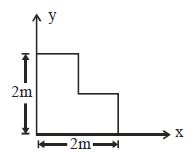
The $x, y$ coordinates of the centre of mass of a uniform $L-$ shaped lamina of mass $3\, kg$ is
The diagrams represent the potential energy $U$ of a function of the inter-atomic distance $r.$  Which diagram corresponds to stable molecules found in nature.
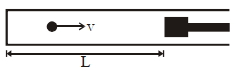
A small particle of mass $m$ moving inside a heavy, hollow and straight tube along the tube axis undergoes elastic collision at two ends. The tube has no friction and it is closed at one end by a flat surface while the other end is fitted with a heavy movable flat piston as shown in figure. When the distance of the piston from closed end is $L = L _0$ the particle speed is $v = v _0$. The piston is moved inward at a very low speed $V$ such that $V \ll \frac{ dL }{ L } v _0$, where $dL$ is the infinitly small displacement of the piston. Which of the following statement($s$) is/are correct?

$(1)$ The rate at which the particle strikes the piston is $v / L$

$(2)$ After each collision with the piston, the particle speed increases by $2 V$

$(3)$ The particle's kinetic energy increases by a factor of $4$ when the piston is moved inward from $L _0$ to $\frac{1}{2} L _0$

$(4)$ If the piston moves inward by $d L$, the particle speed increases by $2 v \frac{d L}{L}$
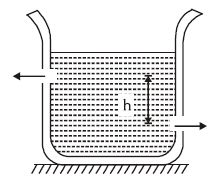
There are two identical small holes of area of cross-section a on the opposite sides of a  tank containing a liquid of density $\rho$. The difference in height between the holes is $h$. Tank  is resting on a smooth horizontal surface. Horizontal force which will have to be  applied on the tank to keep it in equilibrium is
Two waves are propagating to the point $P$ along a straight line produced by two sources $A$ and $B$ of simple harmonic and of equal frequency. The amplitude of every wave at $P$ is $‘a’$ and the phase of $A$ is ahead by $\frac{\pi }{3}$ than that of $B$ and the distance $AP$ is greater than $BP$ by $50 cm.$ Then the resultant amplitude at the point $P$ will be, if the wavelength is $1$ meter