MCQ
When we pay for our electricity bill, we are paying for the :
  • A
    Charge used.
  • B
    Current used.
  • C
    Power used.
  • Energy used.

Answer

Correct option: D.
Energy used.
Electricity bill is measured in units where $1$ unit is equal to kWh which is the unit of energy.
Hence, when we pay for our electricity bill, we pay for the amount of electrical energy consumed by us.

Need a full question paper?

Generate a complete, print-ready paper with questions like this in minutes — across 16+ boards, with answer keys.
Start Generating Free

Similar questions

Select the statements that describe characteristics of genes:
  1. Genes are specific sequence of bases in a $\text{DNA}$ molecule.
  2. A gene does not code for proteins.
  3. In individuals of a given species, a specific gene is located on a particular chromosome.
  4. Each chromosome has only one gene
Which of the following can make a parallel beam of light from a bulb falls on it?
In one of the industrial processes used for manufacture of sodium hydroxide, a gas $X$ is formed as by $-$ product. The gas $X$ reacts with lime water to give a compound $Y$ which is used as a bleaching agent in chemical industry. The compound $X$ and $Y$ could be :
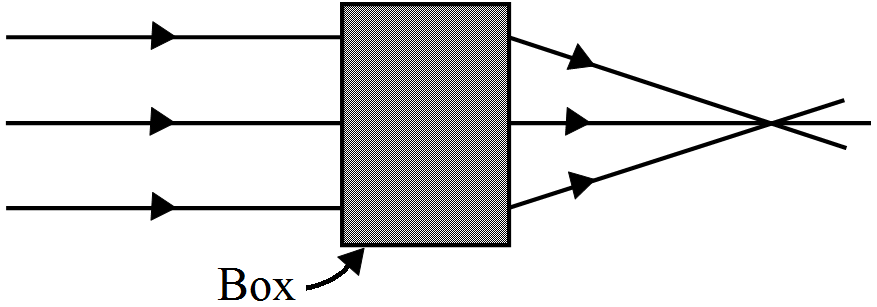
A beam of parallel light rays is incident through the holes on one side of a box and emerges out through the holes on its opposite side as shown in the diagram below : Which of the following could be inside the box?
Solar cell is a device which directly converts $ .......... $ into electric energy :
Only one of the following characteristic of the parents can be inherited by their children. This one is :
In a given food chain, suppose the amount of energy available at the third trophic level is 50 KJ. What will be the energy available at the producer level?
Which of the following statements is true?
According to Mendleev's periodic law which properties of the elements are the periodic function of their atomic masses?
The image formed by a concave mirror is real, inverted and highly diminished (much smaller than the object). The object must be: