MCQ
When you make ice cubes, the entropy of water
  • A
    does not change
  • B
    increases
  • decreases
  • D
    may either increase or decrease depending

Answer

Correct option: C.
decreases
c
$dS = \frac{dQ}{T}$ In freezing process $dQ$ is negative so entropy decreases.

Need a full question paper?

Generate a complete, print-ready paper with questions like this in minutes — across 16+ boards, with answer keys.

Start Generating Free

Similar questions

The component of a vector is:
  1. Always less than its magnitude.
  2. Always greater than its magnitude.
  3. Always equal to its magnitude.
  4. None of these.
In which of the following the final image is erect?
  1. Simple microscope.
  2. Compound microscope.
  3. Astronomical telescope.
  4. Galilean telescope.
Two waves having equations

${x_1} = a\sin (\omega \,t + {\phi _1})$, ${x_2} = a\sin \,(\omega \,t + {\phi _2})$

If in the resultant wave the frequency and amplitude remain equal to those of superimposing waves. Then phase difference between them is
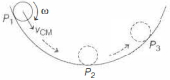
A small ring is rolling without slipping on the circumference of a large bowl as shown below in the figure. The ring is moving down at $P_{1}$, comes down to the lower most point $P_{2}$ and is climbing up at $P_{3}$. Let $v _{ CM }$ denote the velocity of the centre of mass of the ring. Choose the correct statement regarding the frictional force on the ring.edClass-Data Entry
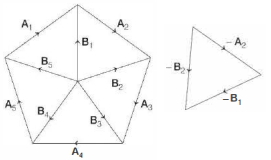
The five sides of a regular pentagon are represented by vectors $A _1, A _2, A _3, A _4$ and $A _5$, in cyclic order as shown below. Corresponding vertices are represented by $B _1, B _2, B _3, B _4$ and $B _5$, drawn from the centre of the pentagon.Then, $B _2+ B _3+ B _4+ B _5$ is equal to
The dimension of $P = \frac{{{B^2}{l^2}}}{m}$ is 

where $B=$ magnetic field, $l=$ length, $m =$ mass
If a body $A$ of mass $M$ is thrown with velocity $v$ at an angle of ${30^o}$ to the horizontal and another body $B$ of the same mass is thrown with the same speed at an angle of ${60^o}$ to the horizontal. The ratio of horizontal range of $A$ to $B$ will be
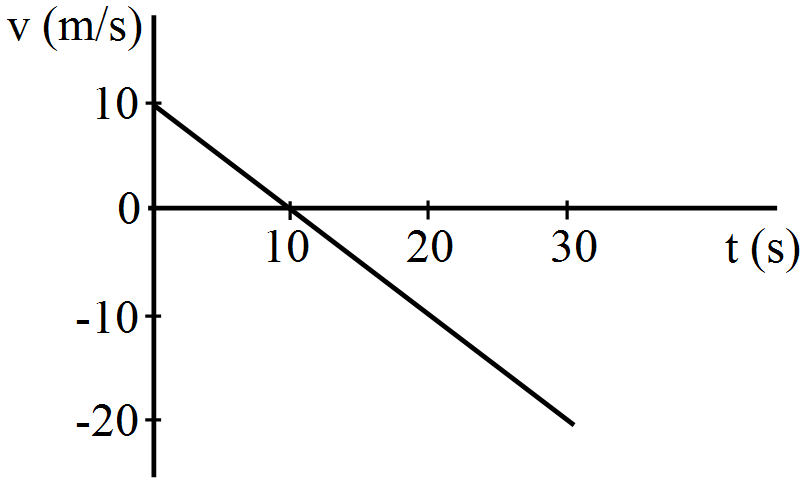
The velocity-time plot for a particle moving on a straight line is shown in the figure:

An object kept in a large room having air temperature of $25^{\circ} \mathrm{C}$ takes $12$ minutes to cool from $80^{\circ} \mathrm{C}$ to $70^{\circ} \mathrm{C}$. The time taken to cool for the same object from $70^{\circ} \mathrm{C}$ to $60^{\circ} \mathrm{C}$ would be nearly.....$min$
A particle is projected with an angle of projection $\theta$ to the horizontal line passing through the points $( P , Q )$ and $( Q , P )$ referred to horizontal and vertical axes (can be treated as $x$-axis and $y$-axis respectively).

The angle of projection can be given by