Question
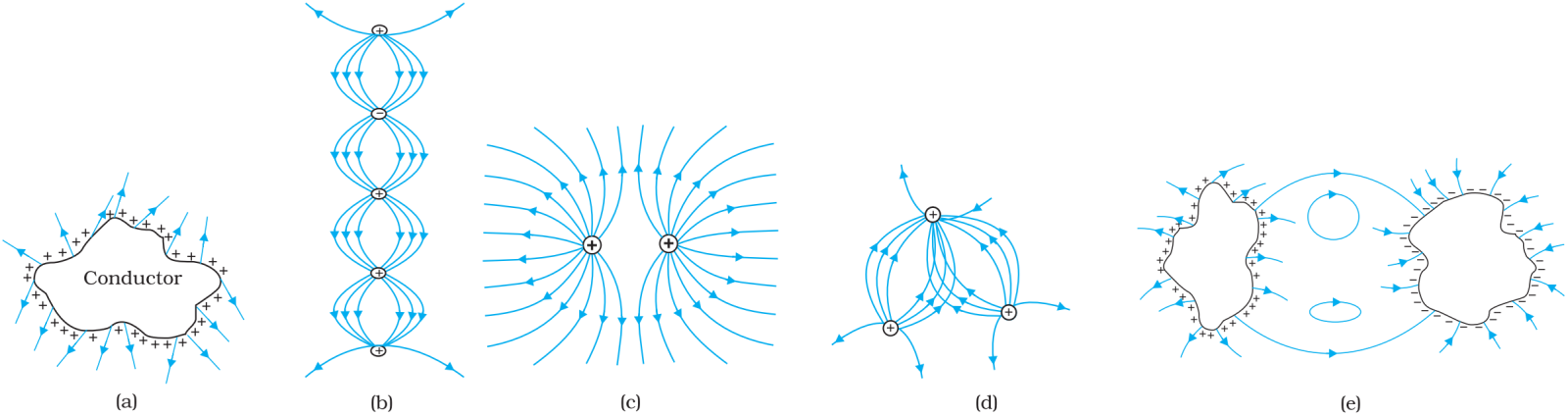
Which among the curves shown in figure cannot possibly represent electrostatic field lines?
Answer

  1. Field lines are wrongly drawn because electric field lines must be normal to the surface of the conductor at each point.
  2. Field lines are wrongly drawn because field lines cannot start from a negative charge.
  3. Field lines are correctly drawn, because they are originating from a positive charge.
  4. Field lines are wrongly drawn as the field lines cannot intersect.
  5. Field lines are wrongly drawn because they cannot form closed loops.

Need a full question paper?

Generate a complete, print-ready paper with questions like this in minutes — across 16+ boards, with answer keys.

Start Generating Free

Similar questions

  1. Define mutual inductance and write its S.I. unit.
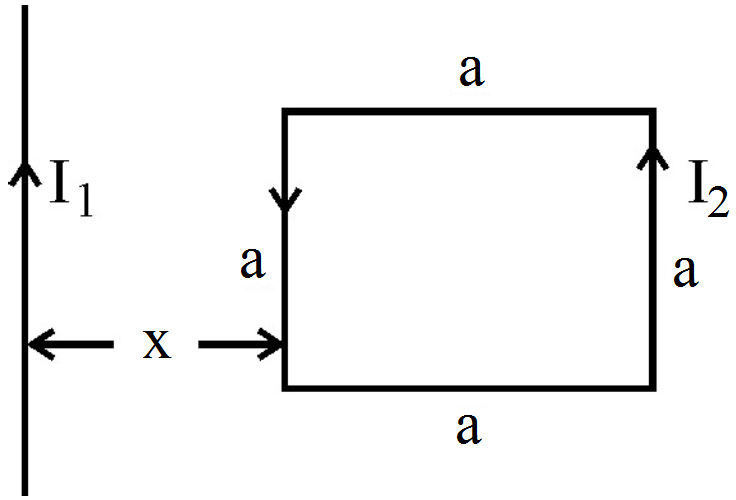
  2. A square loop of side ‘a’ carrying a current I2 is kept at distance x from an infinitely long straight wire carrying a current I1 as shown in the figure. Obtain the expression for the resultant force acting on the loop.

The critical angle for a given piece of glass is 45°. Calculate the polarising angle for it. Also calculate the angle of refraction when light is incident on this glass at an angle of incidence equal to ip.
A long, vertical wire carrying a current of 10A in the upward direction is placed in a region where a horizontal magnetic field of magnitude 2·0 × 10-3T exists from south to north. Find the point where the resultant magnetic field is zero.
Explain the experiment which represents the total internal reflection.
In a Coolidge tube, electrons strike the target and stop inside it. Does the target get more and more negatively charged as time passes?
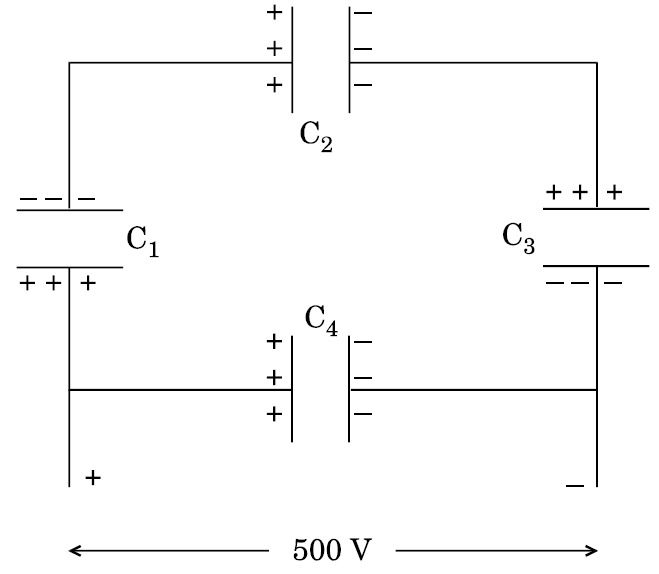
A network of four 10 $\mu$F capacitors is connected to a 500 V supply as shown in the figure. Determine the
  1. equivalent capacitance of the network and
  2. charge on each capacitor

A long straight wire carries a current of 35 A. What is the magnitude of the field B at a point 20 cm from the wire?
What is the force between two small charged spheres having charges of 2 × 10⁻⁷C and 3 × 10⁻⁷C placed 30cm apart in air?
Calculate and compare the energy released by
a. fusion of 1.0 kg of hydrogen deep within Sun and
b. the fission of 1.0 kg of ${ }^{235} U$ in a fission reactor.
When a photon is emitted from an atom, the atom recoils. The kinetic energy of recoil and the energy of the photon come from the difference in energies between the states involved in the transition. Suppose, a hydrogen atom changes its state from n = 3 to n = 2. Calculate the fractional change in the wavelength of light emitted, due to the recoil.