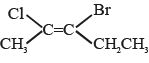
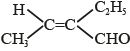
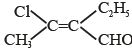
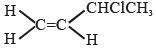
MCQ
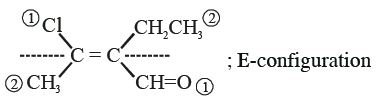
Which among the following has $E$ configuration?
  • A

  • B


  • D

Answer

Correct option: C.

c

Need a full question paper?

Generate a complete, print-ready paper with questions like this in minutes — across 16+ boards, with answer keys.

Start Generating Free

Similar questions

Which of the following compunds will not produce offensive smell when treated with $CHCl_3 / KOH$ ?
The $IUPAC$ name of $[Ni(NH_3)_4]\, [NiCl_4]$ is
The volume of water added to $500\, ml$, $0.5\, M\, NaOH$ so that its strength becomes $10\, mg$ $NaOH$ per $ml$, will be .......... $ml$.
Optically inactive compound is
Which of the following has '$6$' unpaired $f-$electrons ?
A solution of $\mathrm{H}_2 \mathrm{SO}_4$ is $31.4 \% \mathrm{H}_2 \mathrm{SO}_4$ by mass and has a density of $1.25 \mathrm{~g} / \mathrm{mL}$. The molarity of the $\mathrm{H}_2 \mathrm{SO}_4$ solution is _____________$\quad \mathrm{M}$ (nearest integer)[Given molar mass of $\mathrm{H}_2 \mathrm{SO}_4=98 \mathrm{~g} \mathrm{~mol}^{-1}$ ]
At $444\,^oC$ , the equilibrium constant $K$ for the reaction $2A{B_{(g)}} \rightleftharpoons {A_{2(g)}} + {B_{2(g)}}$ is $\frac {1}{64}$ . The degree of dissociation of $AB$ will be .....$\%$
Find the equilibrium constant for equilibrium
$HCO{O^ - } + {H_2}O \rightleftharpoons HCOOH + O{H^ - }$
In a solution of $0.1\, M\, HCOONa$. $K_a(HCOOH) = 1.8 \times 10^{-4}$
The oxidation number of iron in the compound ${K_4}[Fe{(CN)_6}]$ is
The wave function $\psi_{n / m m}$ is a mathematical function whose value depends upon spherical polar coordinates $(r, \theta, \phi)$ of the electron and characterized by the quantum numbers $n, l$ and $m_l$. Here $r$ is distance from nucleus, $\theta$ is colatitude and $\phi$ is azimuth. In the mathematical functions given in the Table, $\mathrm{Z}$ is atomic number and $a_0$ is Bohr radius.

$column 1$ $column 2$ $column 3$
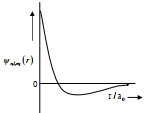
$(I)$ $1$s orbital $(i)$ $\psi_{n, l, m_l} \propto\left(\frac{Z}{a_0}\right)^{\frac{3}{2}} e^{-\left(\frac{Z r}{a_0}\right)}$ $image$
($II$) $2 \mathrm{~s}$ orbital $(ii)$ One radial node $(Q)$ Probability density at nucleus $\propto \frac{1}{a_0^3}$
$(III)$ $2 p_z$ orbital $(iii)$ $\psi_{n, l m_l} \propto\left(\frac{Z}{a_0}\right)^{\frac{5}{2}} r e^{-\left(\frac{Z r}{2 a_0}\right)} \cos \theta$ $(R)$ Probability density is maximum at nucleus
$(IV)$ $3 \mathrm{~d}_{\mathrm{z}}^2$ orbital $(iv)$ $x y$-plane is a nodal plane $(S)$ Energy needed to excite electron from $n=2$ state to $n=4$ state is $\frac{27}{32}$ times the energy needed to excite electron from $n=2$ state to $n=6$ state

($1$) For the given orbital in Column $1$, the only $CORRECT$ combination for any hydrogen-like species is

$[A] (IV) (iv) (R)$   $[B] (II) (ii) (P)$    $[C] (III) (iii) (P)$    $[D] (I) (ii) (S)$

($2$)  For $\mathrm{He}^{+}$ion, the only INCORRECT combination is

$[A] (II) (ii) (Q)$ $[B] (I) (i) (S)$ $[C] (I) (i) (R)$ $[D] (I) (iii) (R)$

($3$) For hydrogen atom, the only $CORRECT$ combination is

$[A] (I) (iv) (R)$   $[B] (I) (i) (P)$    $[C] (II) (i) (Q)$   $[D] (I) (i) (S)$

Give the answer quetion ($1$) ($2$) and ($3$)