MCQ
Which among the following materials display higher magnetic susceptibility?
- AFerromagnetic material.
- BParamagnetic material.
- CDiamagnetic material.
- DNone of these options.
Explanation:
Ferromagnetic materials display higher magnetic susceptibility.
Generate a complete, print-ready paper with questions like this in minutes — across 16+ boards, with answer keys.
A circular metal plate of radius R is rotating with a uniform angular velocity ω with its plane perpendicular to a uniform magnetic field B. Then the emf developed between the centre and the rim of the plate is
|
(a) πω |
(b) ω |
(c) πω |
(d) ω |
Two concave lenses L1 and L2 are kept in contact with each other. If the space between the two lenses is filled with a material of refractive index $\mu\approx1,$ the magnitude of the focal length of the combination:
Electric potential of earth is taken to be zero because earth is a good
|
(a) Insulator |
(b) Conductor |
(c) Semiconductor |
(d) Dielectric |
If the wavelength of light is 4000 Å, then the number of waves in 1 mm length will be
|
(a) 25 |
(b) 0.25 |
(c) 0.25 |
(d) 25 |
The plates of a capacitor are charged to a potential difference of 320 volts and are then connected across a resistor. The potential difference across the capacitor decays exponentially with time. After 1 second the potential difference between the plates of the capacitor is 240 volts, then after 2 and 3 seconds the potential difference between the plates will be
|
(a) 200 and 180 V |
(b) 180 and 135 V |
(c) 160 and 80 V |
(d) 140 and 20 V |
The equivalent resistance of the arrangement of resistances shown in adjoining figure between the points A and B is
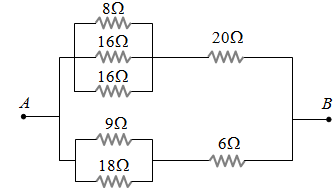
|
(a) 6 ohm |
(b) 8 ohm |
(c) 16 ohm |
(d) 24 ohm |


