MCQ
Which enzyme converts glucose to ethanol?
  • A
    Diesterase
  • B
    Invertase
  • C
    Zymase
  • D
    Both (2) and (3)

Answer

  1. Zymase

Explanation:

Glucose → Ethanol

Zymase enzymes can do above conversion.

(catalyzes fermentation of sugar into ethanol & CO2​).

Need a full question paper?

Generate a complete, print-ready paper with questions like this in minutes — across 16+ boards, with answer keys.
Start Generating Free

Similar questions

Compound formed by the hydration of Propyne (CH3 - C = CH) is:
In Birkeland-Eyde process, the raw material used is
Which of the following reactions will NOT give primary amine as the product?
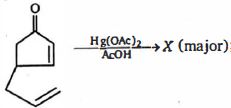
Product $(X)$ is
$\begin{gathered}
  \begin{array}{*{20}{c}}
  {O\,\,\,\,\,\,\,\,\,\,\,\,\,\,\,\,\,\,\,\,\,\,\,\,\,\,\,\,\,\,\,\,\,\,\,\,\,\,\,\,\,\,\,\,\,\,\,\,\,\,\,\,\,\,\,\,\,\,\,\,\,\,\,\,\,\,\,\,\,\,\,\,\,\,} \\ 
  {||\,\,\,\,\,\,\,\,\,\,\,\,\,\,\,\,\,\,\,\,\,\,\,\,\,\,\,\,\,\,\,\,\,\,\,\,\,\,\,\,\,\,\,\,\,\,\,\,\,\,\,\,\,\,\,\,\,\,\,\,\,\,\,\,\,\,\,\,\,\,\,\,\,\,} \\ 
  {C{H_3} - {\text{  }}C - {\text{ }}O - H\xrightarrow{{NaH{{\mathop {CO}\limits^{14} }_3}}}\mathop {(A)}\limits_{(gas)} \xrightarrow[{(ii){H_3}{O^ \oplus }}]{{(i)PhMgBr}}(B)} 
\end{array} \hfill \\
  \begin{array}{*{20}{c}}
  {O\,\,\,\,\,\,\,\,\,\,\,\,\,\,\,\,\,\,\,\,\,\,\,\,\,\,\,\,\,\,\,\,\,\,\,\,\,\,\,\,\,\,\,\,\,\,\,\,\,\,\,\,\,\,\,\,\,\,\,\,\,\,\,\,\,\,\,\,\,\,\,\,\,\,} \\ 
  {||\,\,\,\,\,\,\,\,\,\,\,\,\,\,\,\,\,\,\,\,\,\,\,\,\,\,\,\,\,\,\,\,\,\,\,\,\,\,\,\,\,\,\,\,\,\,\,\,\,\,\,\,\,\,\,\,\,\,\,\,\,\,\,\,\,\,\,\,\,\,\,\,\,\,} \\ 
  {C{H_3} - S - O - H\xrightarrow{{NaH\mathop {C{O_3}}\limits^{14} }}\mathop {(C)}\limits_{(gas)} \xrightarrow[{(ii){H_3}{O^ \oplus }}]{{(i)PhMgBr}}(D)} \\ 
  {||\,\,\,\,\,\,\,\,\,\,\,\,\,\,\,\,\,\,\,\,\,\,\,\,\,\,\,\,\,\,\,\,\,\,\,\,\,\,\,\,\,\,\,\,\,\,\,\,\,\,\,\,\,\,\,\,\,\,\,\,\,\,\,\,\,\,\,\,\,\,\,\,\,\,\,} \\ 
  {O\,\,\,\,\,\,\,\,\,\,\,\,\,\,\,\,\,\,\,\,\,\,\,\,\,\,\,\,\,\,\,\,\,\,\,\,\,\,\,\,\,\,\,\,\,\,\,\,\,\,\,\,\,\,\,\,\,\,\,\,\,\,\,\,\,\,\,\,\,\,\,\,\,\,\,\,} 
\end{array} \hfill \\ 
\end{gathered}$

Product $(B)$ and $(D) $ in the above reaction are

Which of following is/are correct ?

$(A)$ Nucleotide form from nucleoside and phosphate group by ether linkage

$(B)$ In nucleoside, nitrogenous base link with hexose sugar of $DNA$ or $RNA$

$(C)$ $DNA$ and $RNA$ are differ in only nature of sugar

$(D)$ $A = T$ and $C \equiv G$ are hydrogen bond between nitrogenous base
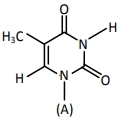
The compound $'A'$ is a complementary base of in $DNA$ stands.
The end product of the reactions is

${{C}_{2}}{{H}_{5}}N{{H}_{2}} \xrightarrow{HN{{O}_{2}}}A \xrightarrow{PC{{l}_{5}}}B \xrightarrow{H.N{{H}_{2}}}C$

In chromyl chloride test, oxidation state of $Cr$ changes from
Benzene and toluene form nearly ideal solutions. At $20\,^o C, $ the vapour pressure of benzene is $75\,torr$ and that of toluene is $22\,torr$. The parial vapour pressure of benzene at $20\,^o C$  for a solution containing $78\, g $ of benzene and $46\,g$  of toluene in torr is