MCQ
Which forms coloured salts
  • A
    Metals
  • B
    Non-metals
  • C
    $p -$  block elements
  • Transitional elements

Answer

Correct option: D.
Transitional elements
d
(d)Transitional elements form coloured salts due to the presence of unpaired electrons in $ d-$ orbital.

Need a full question paper?

Generate a complete, print-ready paper with questions like this in minutes — across 16+ boards, with answer keys.

Start Generating Free

Similar questions

$p$-Amino- $N, N$-dimethylaniline is added to a strongly acidic solution of ${X}$. The resulting solution is treated with a few drops of aqueous solution of ${Y}$ to yield blue coloration due to the formation of methylene blue. Treatment of the aqueous solution of ${Y}$ with the reagent potassium hexacyanoferrate$(II)$ leads to the formation of an intense blue precipitate. The precipitate dissolves on excess addition of the reagent. Similarly, treatment of the solution of ${Y}$ with the solution of potassium hexacyanoferrate$(III)$ leads to a brown coloration due to the formation of ${Z}$.

$1.$ The compound ${X}$ is

$(A)$ $\mathrm{NaNO}_3$ $(B)$ $\mathrm{NaCl}$ $(C)$ $\mathrm{Na}_2 \mathrm{SO}_4$ $(D)$ $\mathrm{Na}_2 \mathrm{~S}$

$2.$ The compound ${Y}$ is

$(A)$ $\mathrm{MgCl}_2$ $(B)$ $\mathrm{FeCl}_2$ $(C)$ $\mathrm{FeCl}_3$ $(D)$ $\mathrm{ZnCl}_2$

$3.$ The compound ${Z}$ is

$(A)$ $\left.\mathrm{Mg}_2 \mid \mathrm{Fe}(\mathrm{CN})_6\right]$ $(B)$ $\operatorname{Fe}\left[\mathrm{Fe}(\mathrm{CN})_6\right]$

$(C)$ $\mathrm{Fe}_4\left[\mathrm{Fe}(\mathrm{CN})_6\right]_3$ $(D)$ $\mathrm{K}_2 \mathrm{Zn}_3\left[\mathrm{Fe}(\mathrm{CN})_6\right]_2$

Give the answer question $1,2$ and $3.$

Acetic anhydride reacts with excess of ammonia to form
Which of the following will have standard oxidation potential less than $SHE$
A group $13$ element $'X'$  reacts with chlorine gas to produce a compound  $XCl_3. XCl_3$ is electron deficient and easily reacts with $NH_3$ to form $Cl_3X \leftarrow NH_3$ adduct, however, $XCl_3$ does not dimerize. $X$  is
Diborane $(B_2H_6)$ reacts independently with $O_2$ and $H_2O$ to produce, respectively
Match the thermodynamic processes given under Column $I$ with the expression given under Column $II$:
Column $I$ Column $II$
$(A)$ Freezing of water at $273 K$ and $1 \ atm$ $(P)$ $q =0$
$(B)$ Expansion of $1 \ mol$ of an ideal gas into a vacuum under isolated conditions $(Q)$ $w=0$
$(C)$ Mixing of equal volumes of two ideal gases at constant temperature and pressure in an isolated container $(R)$ $\Delta S _{\text {sy5 }} < 0$
$(D)$ Reversible heating of $H _2( g )$ at $1 \ atm$ from $300 \ K$ to $600 \ K$, followed by reversible cooling to $300 \ K$ at $1 \ atm$ $(S)$ $\Delta U =0$
  $(T)$ $\Delta G =0$
In a reversible reaction $A\underset{{{k_2}}}{\overset{{{k_1}}}{\longleftrightarrow}}B,$ the initial concentration of $A$ and  $B$ are $a$ and $b$ and the equilibrium concentration are $(a -x)$ and $(b + x)$ respectively. Express $"x"$ in terms of $k_1, k_2,$ $a$ and $b$
The O.P. of equimolar solution of Urea, $BaC{l_2}$ and $AlC{l_3}$, will be in the order
Which one of the following reactions would be the best for the formation of $2-$   bromobutane

$(1)$ $C{H_3}CH = CHC{H_2}C{H_3}$  $  \xrightarrow{HBr}  $

$(2)$ $C{H_3}C{H_2}CH = C{H_2}$  $  \xrightarrow{HBr}  $

$(3)$ $C{H_3}CH = CHC{H_3}$   $  \xrightarrow{Br_2}  $

$(4)$ $C{H_3}C{H_2}CH = C{H_2}\mathop {}\limits_{{\rm{}}} $  $  \xrightarrow[Proxide]{HBr}  $
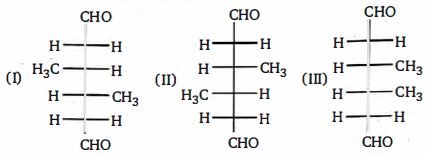
Which of the following statements best describes the stereochemical relationships  of compound $I, II$ and $III$ shown below ?