MCQ
Which gives $C{H_4}$ when treated with water
  • A
    Silicon carbide
  • B
    Calcium carbide
  • Aluminium carbide
  • D
    Iron carbide

Answer

Correct option: C.
Aluminium carbide
c
(c) $\mathop {A{l_4}{C_3}}\limits_{{{Aluminium }} {\rm{carbide}}}$  +   $ 6{H_2}O$ $\longrightarrow $ $\underset {Methane} {3CH_4}$ + $2A{l_2}{O_3}$

Need a full question paper?

Generate a complete, print-ready paper with questions like this in minutes — across 16+ boards, with answer keys.

Start Generating Free

Similar questions

For the reaction at $300\,K$

$A(g) + B(g) \to C(g)$  $\Delta U=\,-\,3\,Kcal$

                                             $\Delta S=\,-\,10\,cal/K$

value of $\Delta G$ will be ......$cal$

The metal atom present in the complex MABXL (where $\mathrm{A}, \mathrm{B}, \mathrm{X}$ and $\mathrm{L}$ are unidentate ligands and $\mathrm{M}$ is metal) involves $\mathrm{sp}^3$ hybridization. The number of geometrical isomers exhibited by the complex is:
The $e.m.f.$ of the following galvanic cells are represented by $E_1, E_2, E_3$ and $E_4$. Which of the following statement is true

$(i)$ $Zn|Zn^{2+}\,(1\,M)||Cu^{2+}\,(1\,M)|Cu$

$(ii)$ $Zn|Zn^{2+}\,(0.1\,M)||Cu^{2+}\,(1\,M)|Cu$

$(iii)$ $Zn|Zn^{2+}\,(1\,M)||Cu^{2+}\,(0.1\,M)|Cu$

$(iv)$ $Zn|Zn^{2+}(0.1\,M)||Cu^{2+}\,(0.1\,M)|Cu$
$\begin{array}{*{20}{c}}
  {C{H_3} - CH - C{H_2} - C{H_3}\xrightarrow[{hv}]{{C{l_2}}}(x)} \\ 
  {|\,\,\,\,\,\,\,\,\,\,\,\,\,\,\,\,\,\,\,\,\,\,\,\,\,\,\,\,\,\,\,\,\,\,\,\,\,\,\,\,\,} \\ 
  {C{H_3}\,\,\,\,\,\,\,\,\,\,\,\,\,\,\,\,\,\,\,\,\,\,\,\,\,\,\,\,\,\,\,\,\,\,\,\,} 
\end{array} =$ Number of monochloro product including stereoisomers.
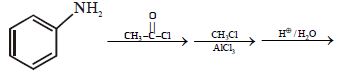
Identify major product of following sequence of reaction
The correct order of basicity in amines

$(i)$ ${C_4}{H_5}N{H_2}$          $(ii)$ $C{H_3}N{H_2}$

$(iii)$ ${(C{H_3})_2}NH$            $ (iv)$ ${(C{H_3})_3}N$

Catalyst used in dimerisation of acetylene to prepare chloroprene is
Which of the following has max. solubility at low $pH$?
Alkylamine dissolve in hydrochloric acid to form alkylammonium chloride. The nitrogen in the latter salt is:
Identify the factor from the following that does not affect electrolytic conductance of a solution.