MCQ
Which group among the following is insulator?
- ASilver, copper, gold
- BPaper, glass, cotton
- CThe human body, wood, iron
- DGlass, copper, paper
Explanation:
Glass, paper, and cotton are good quality insulators. The rest options contain one or more conducting materials. Silver is the best conductor material available in nature. But it is costly, so it can’t be used in the electricity distribution system.
Generate a complete, print-ready paper with questions like this in minutes — across 16+ boards, with answer keys.
In a PN-junction
|
(a) P and N both are at same potential |
|
(b) High potential at N side and low potential at P side |
|
(c) High potential at P side and low potential at N side |
|
(d) Low potential at N side and zero potential at P side |
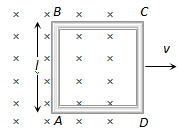
A conducting square loop of side l and resistance R moves in its plane with a uniform velocity v perpendicular to one of its sides. A magnetic induction B constant in time and space, pointing perpendicular and into the plane at the loop exists everywhere with half the loop outside the field, as shown in figure. The induced e.m.f. is
|
(a) Zero |
(b) RvB |
(c) VBl/R |
(d) VBl |
For a triode, at  volt, the following observations were taken
 ,
,  . The value of plate resistance will be
|
(a) 25 kW |
(b) 20.8 kW |
(c) 12.5 kW |
(d) 100 kW |
Using a bar magnet P, a vibration magnetometer has time period 2seconds. When a bar Q (identical to P in mass and size) is placed on top of P, the time period is unchanged. Which of the following statements is true
| (a) Q is of non-magnetic material |
|
(b) Q is a bar magnet identical to P, and its north pole placed on top of P's north pole |
| (c) Q is of unmagnetized ferromagnetic material |
| (d) Nothing can be said about Q's properties |
We use flint glass prism to disperse polychromatic light because light of different colours
|
(a) Travel with same speed |
|
(b) Travel with same speed but deviate differently due to the shape of the prism |
|
(c) Have different anisotropic properties while travelling through the prism |
|
(d) Travel with different speeds |
In a region of uniform magnetic induction  , a circular coil of radius 30 cm and resistance
  ohm is rotated about an axis which is perpendicular to the direction of B and which forms a diameter of the coil. If the coil rotates at 200 rpm the amplitude of the alternating current induced in the coil is
|
(a) |
(b) 30 mA |
(c) 6 mA |
(d) 200 mA |
