MCQ
Which has more luminous efficiency
  • A
    A $40 W$ bulb
  • A $40 W$ fluorescent tube
  • C
    Both have same
  • D
    Cannot say

Answer

Correct option: B.
A $40 W$ fluorescent tube
b
(b) Luminous efficacy is a measure of how well a light source produces visible light. It is the ratio of luminous flux to power, measured in lumens per watt in SI.Luminous efficacy can be normalized by the maximum possible luminous efficacy to a dimensionless quantity called luminous efficiency.

Luminous efficiency for the same power supply, $40 W$ fluorescent tube gives more light. Hence, $40 \mathrm{W}$ fluorescent tube has greater.

Need a full question paper?

Generate a complete, print-ready paper with questions like this in minutes — across 16+ boards, with answer keys.
Start Generating Free

Similar questions

If the coefficient of mutual induction of the primary and secondary coils of an induction coil is $5\, H$ and a current of $10\, A$ is cut off in $5\times10^{-4}\, s$, the $emf$ inducted (in $volt$) in the secondary coil is
A proton and an alpha particle are separately projected in a region where a uniform magnetic field exists. Their initial velocities are perpendicular to direction of magnetic field. If both the particles move around magnetic field in circles of equal radii, the ratio of momentum of proton to alpha particle $\left( {\frac{{{P_p}}}{{{P_\alpha }}}} \right)$ is
The ratio of wavelengths of the last line of Balmer series and the last line of Lyman series is
An electron from various excited states of hydrogen atom emit radiation to come to the ground state. Let $\lambda_v, \lambda_g$ be the de Broglie wavelength of the electron in the $n^{th}$ state and the ground state respectively. Let $\Lambda_n$ be the wavelength of the emitted photon in the transition from the $n^{th}$ state to the ground state. For large $n, (A, B $ are constants)
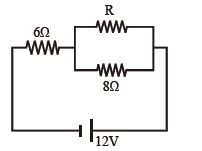
In the circuit shown in figure, the power which is dissipated as heat in the $6\,\Omega$ resistor is $6\,W$. What is the value of resistance $R$ in the circuit?................... $\Omega$
A person's near point is 50 cm and his far point is 3 m. Power of the lenses he requires for
(i) reading and (ii) for seeing distant stars are
A person runs with a speed u towards a bicycle moving away from him with speed $v.$ The person approaches his image in the mirror fixed at the rear of bicycle with a speed of
By putting a magnetic substance of volume $30\, cm^3$ in a magnetising field of strength $\frac{1250}{\pi}$ $ampere/ metre$ the value of produced magnetic moment is $6\,A/m^2$ then calculate the value of magnetic induction produced in the substance .......$T$
The self-inductance of a long solenoid carrying current is independent of:
A compass needle of oscillation magnetometer oscillates $20$ times per minute at a place $P$ of dip $30^{\circ}$. The number of oscillations per minute become $10$ at another place $Q$ of $60^{\circ} dip$. The ratio of the total magnetic field at the two places $\left(B_{Q}: B_{p}\right)$ is.