MCQ
Which is a vector quantity
  • A
    Density
  • B
    Magnetic flux
  • Intensity of magnetic field
  • D
    Magnetic potential

Answer

Correct option: C.
Intensity of magnetic field
c
(c)

Need a full question paper?

Generate a complete, print-ready paper with questions like this in minutes — across 16+ boards, with answer keys.

Start Generating Free

Similar questions

A charged particle initially at rest at $O$,when released follows a trajectory as shown alongside. Such a trajectory is possible in the presence of
In an a.c. curent the $e.m.f$ $(\varepsilon)$ and the current $(i)$ at any instant are given respectively by  $E=E_o sin\,\,\omega t$ ,$i=I_o sin$$\left( {\omega t - \phi } \right)$  The average power in the circuit over one cycle of $a.c.$ is
An $X$-ray tube has a short wavelength end at $0.45 \mathring A$. The voltage of tube is ........ $V$
Bartholinus discovered:
A convex lens of crown glass ($n =1.525$) will behave as a divergent lens if immersed in
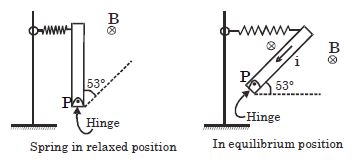
A thin uniform rod with negligible mass and length $l$ is attached to the floor by a frictionless hinge at point $P$ . A horizontal spring with force constant $k$ connects the other end to wall. The rod is in a uniform magnetic field $B$ directed into the plane of paper. What is extension in spring in equilibrium when a current $i$ is passed through the rod in direction shown. Assuming spring to be in natural length initially.
A magnifying glass is used to read the newspaper. As it is moved far away from the newspaper:
Experimentally it is found that $12.8\,eV$ energy is required to separate a hydrogen atom into a proton and an electron. So the orbital radius of the electron in a hydrogen atom is $\frac{9}{ x } \times 10^{-10}\,m$. The value of the $x$ is $\left(1\,eV =1.6 \times 10^{-19}\,J , \frac{1}{4 \pi \in_0}=9 \times 10^9\,Nm ^2 / C ^2\right.$ and electronic charge $=1.6 \times 10^{-19}\,J\,C$ )
In which frequency range, space waves are normally propagated
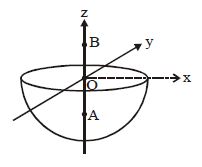
Consider $a$ uniformly charged hemispherical shell of radius $R$ and charge $Q$ . If field at point $A (0, 0, -z_0)$ is $ \vec E$ then field at point $(0, 0, z_0)$ is $[z_0 < R]$