MCQ
Which is most reactive for $SN^2$ reaction
  • A

  • B


  • D

Answer

Correct option: C.

c

Need a full question paper?

Generate a complete, print-ready paper with questions like this in minutes — across 16+ boards, with answer keys.

Start Generating Free

Similar questions

The order of a reaction is said to be $ 2 $ with respect to a reactant $X, $ when
Ionization enthalpy of an atom is equal to
$\begin{array}{*{20}{c}}
  {C{H_3} - CH - CH = C{H_2} + HBr \to X\,\left( {major\,product} \right)} \\ 
  {|\,\,\,\,\,\,\,\,\,\,\,\,\,\,\,\,\,\,\,\,\,\,\,\,\,\,\,\,\,\,\,\,\,\,\,\,\,\,\,\,\,\,\,\,\,\,\,\,\,\,\,\,\,\,\,\,\,\,\,\,\,\,\,\,\,\,\,\,\,\,\,\,\,\,\,\,\,\,\,\,\,\,\,\,\,\,\,\,\,\,\,\,\,\,\,\,\,\,\,\,\,\,\,\,\,\,} \\ 
  {C{H_3}\,\,\,\,\,\,\,\,\,\,\,\,\,\,\,\,\,\,\,\,\,\,\,\,\,\,\,\,\,\,\,\,\,\,\,\,\,\,\,\,\,\,\,\,\,\,\,\,\,\,\,\,\,\,\,\,\,\,\,\,\,\,\,\,\,\,\,\,\,\,\,\,\,\,\,\,\,\,\,\,\,\,\,\,\,\,\,\,\,\,\,\,\,\,\,\,\,\,} 
\end{array}$

$X$ is

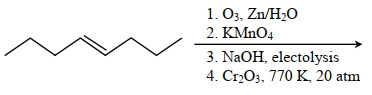
The number of $- CH _2$ - (methylene) groups in the product formed from the following reaction sequence is. . . . . . . 
$1.25 \,g$ of a solid dibasic acid is completely neutralised by $25\, ml$ of $0.25$ molar $Ba{(OH)_2}$ solution. Molecular mass of the acid is
Which one of the following represents the electronic configuration of the most electropositive element
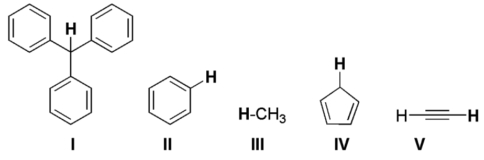
With respect to the compounds $I-V$, choose the correct statement($s$).

$(A)$ The acidity of compound $I$ is due to delocalization in the conjugate base.

$(B)$ The conjugate base of compound IV is aromatic.

$(C)$ Compound II becomes more acidic, when it has a $- NO _2$ substituent.

$(D)$ The acidity of compounds follows the order $I > IV > V > II > III$.
Compound $(X)$ will be

Compound $(X)$ $\xrightarrow[{Pt}]{{5{H_2}}}$ 

Compound $(X)$ $\xrightarrow{{AgN{O_3}}}$ Precipitate

Compound $(X)$ $\xrightarrow[{M{e_2}S}]{{{O_3}}}$ $\begin{array}{*{20}{c}}
  {\,\,\,\,\,\,\,O\,\,\,\,\,\,\,\,\,\,\,\,\,\,\,\,\,\,\,\,\,\,\,\,\,\,\,\,\,\,\,\,\,\,\,\,\,\,\,\,\,\,\,O\,\,\,\,\,\,\,\,\,\,O\,\,\,\,} \\ 
  {\,\,\,\,\,\,\,\,\,\,\,\,\,\,\,\,\,\,\,||\,\,\,\,\,\,\,\,\,\,\,\,\,\,\,\,\,\,\,\,\,\,\,\,\,\,\,\,\,\,\,\,\,\,\,\,\,\,\,\,\,\,\,\,\,||\,\,\,\,\,\,\,\,\,\,||\,\,\,\,\,\,\,\,\,\,\,\,\,\,\,\,\,\,} \\ 
  {H - C - C{H_2} - C{H_2} - C - C - H} 
\end{array}$ $\begin{array}{*{20}{c}}
  {\,\,O\,\,\,\,\,\,O\,\,\,\,\,\,\,\,\,\,} \\ 
  {||\,\,\,\,\,\,\,\,||\,\,\,\,\,\,\,\,\,} \\ 
  {H - C - C - O - H} 
\end{array}$ $ + \begin{array}{*{20}{c}}
  {O\,\,\,\,\,\,\,} \\ 
  {||\,\,\,\,\,\,\,\,} \\ 
  {H - C - O - H} 
\end{array}$ $ + \begin{array}{*{20}{c}}
  {CHO} \\ 
  {|\,\,\,\,\,\,\,\,} \\ 
  {CHO} 
\end{array}$

The strongest acid amongst the following is
$s-$character in $sp$ hybridised orbitals are