Question
Which is not an electrostatic phenomenon:

Answer

  1. Heat is generated in a resistor carrying current.
Explanation:
 
(d) is based on Joule's Law.
Rest are electrostatic phenomenon.

Need a full question paper?

Generate a complete, print-ready paper with questions like this in minutes — across 16+ boards, with answer keys.
Start Generating Free

Similar questions

The graph of ln$\Big(\frac{\text{R}}{\text{R}_{\text{0}}}\Big)$ versus In A (R = radius of a nucleus and A - its mass number) is:
An electron and a proton are both released from rest 1 meter from a large stationary negative charge, considering only the force from the large stationary negative charge on the proton and electron. Which of the following is true?
In a cyclotron, a charged particle.
A person A can clearly see objects between 25cm and 200cm. Which of the following may represent the range of clear vision for a person B having muscles stronger than A, but all other parameters of eye identical to that of A?
  1. 25cm to 200cm.
  2. 18cm to 200cm.
  3. 25cm to 300cm.
  4. 18cm to 300cm.
Two charges are placed a certain distance apart in air. If a brass plate is introduced between them, the force between them will:
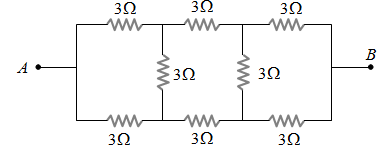
Calculate the equivalent resistance between $A$ and $B$
Two capacitors of $3\ pF$ and $6\ pF$ are connected in series and a potential difference of $5000 V$ is applied across the combination. They are then disconnected and reconnected in parallel. The potential between the plates is
Quantam nature of light is explained by which of the following phenomenon(a) Huygen wave theory(b) Photoelectric effect(c) Maxwell electromagnetic theory(d) de-Broglie theory
   
   
According to the classical theory, the circular path of the electrons is:
The frequency of incident light falling on a photosensitive metal plate is doubled, the kinetic energy of the emitted photoelectrons is.