MCQ
Which is suitable reagent for above reaction
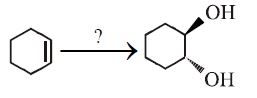
- Acold $KMnO_4$
- ✓$(i) CF_3CO_3H$; $(ii)$ ${H_3}{O^ \oplus }$
- C$(i) OsO_4$ $(ii)$ ${}^\Theta OH/{H_2}O$
- D$(i) O_3$ $(ii) H_2O/Zn$
Generate a complete, print-ready paper with questions like this in minutes — across 16+ boards, with answer keys.
${K_2}Cr_2{O_7}/{H^ + } + y \to \mathop {C{r^{ + 3}} + Others}\limits_{(green)\,\,\,\,\,\,\,\,\,\,\,\,\,\,\,\,\,\,\,\,\,\,\,\,\,\,\,\,\,\,\,\,\,\,\,\,} $
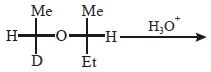
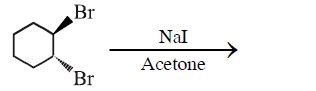
List $-I$
$(A){\mkern 1mu} {\mkern 1mu} {\mkern 1mu} {C_6}{H_6} + CO + HCl\,\xrightarrow{{AlC{l_3}}}\,{C_6}{H_5}CHO$
$(B){\mkern 1mu} {\mkern 1mu} {\mkern 1mu} {C_6}{H_5} + C{H_3}$ $\xrightarrow{{Cr{O_2}C{l_2}}}\,{C_6}{H_5}CHO$
$(C){\mkern 1mu} {\mkern 1mu} {\mkern 1mu} {C_6}{H_5}C{H_2}Br\, + \,C{H_3}Br$ $\xrightarrow{{Na/ether}}\,{C_6}{H_5}C{H_2}C{H_3}$
$(D){\mkern 1mu} {\mkern 1mu} {\mkern 1mu} {C_6}{H_6}\, + \,{(C{H_3})_2}C = C{H_2}$ $\xrightarrow{{{H_2}S{O_4}}}\,{C_6}{H_5}C{(C{H_3})_3}$
List $-II$
$(a)$ Friedel-Crafts reaction
$(b)$ Wurtz-Fitting reaction
$(c)$ Gattermann-Koch Aldehyde synthesis
$(d)$ Etard’s reaction
$(I)\,\,\,\,{N_2} + 2{O_2} \rightleftharpoons 2N{O_2}$
$(II)\,\,\,\,2N{O_2} \rightleftharpoons {N_2} + 2{O_2}$
$(III)\,\,\,\,N{O_2} \rightleftharpoons \frac{1}{2}{N_2} + 2{O_2}$
The correct relation from the following is