MCQ
Which is the frequency range of gamma rays from the following?
- A1 × 1018 to 3 × 10²² Hz
- B3 × 10-18 to 5 × 10²² Hz
- C3 × 1018 to 5 × 10²² Hz
- D3 × 10-18 to 5 × 10-22 Hz
Explanation:
The frequency range of Gamma rays is 3 × 10¹⁸ to 5 × 10²² Hz. These rays have a wavelength of 6 × 10-13 to 10-10m. Gamma rays are produced in nuclear reactions and are also emitted by radioactive nuclei.
Generate a complete, print-ready paper with questions like this in minutes — across 16+ boards, with answer keys.
If an electron jumps from 1st orbital to 3rd orbital, then it will
|
(a) Absorb energy |
(b) Release energy |
|
(c) No gain of energy |
(d) None of these |
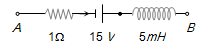
The network shown in the figure is a part of a complete circuit. If at a certain instant the current i is 5 A and is decreasing at the rate of  then
then  is
is
|
(a) 5 V |
(b) 10 V |
(c) 15 V |
(d) 20 V |
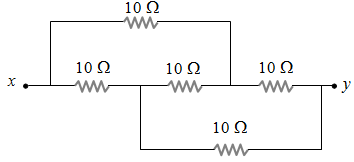
The equivalent resistance between x and y in the circuit shown is
|
(a) 10 W |
(b) 40 W |
(c) 20 W |
(d) |
The relative permeability ( of a ferromagnetic substance varies with temperature (T) according to the curve

|
(a) A |
(b) B |
(c) C |
(d) D |
