MCQ
Which of the following alcohol does not give a stable compound on dehydration?
  • A
    Ethyl alcohol
  • Methyl alcohol
  • C
    $n-$propyl alcohol
  • D
    $n-$butyl alcohol

Answer

Correct option: B.
Methyl alcohol
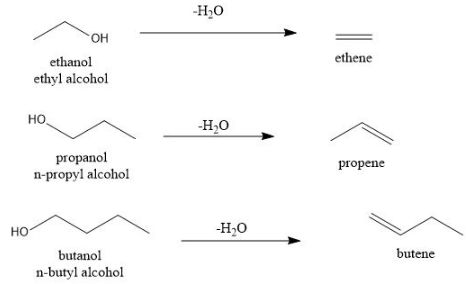
Alcohols undergo dehydration $($removal of water$)$ to form an alkene.
To form alkene, we need at least two carbon atoms. But, methanol $(\mathrm{CH}_3 \mathrm{OH})$ has only one carbon atom. So, it does not give a stable compound on dehydration.

Need a full question paper?

Generate a complete, print-ready paper with questions like this in minutes — across 16+ boards, with answer keys.

Start Generating Free

Similar questions

Give the best conditions for this transformation
The best reagent for converting $2-$ phenyl propanamide into $2-$ phenyl propanamine is
$8\,g$ of $NaOH$ is dissolved in $18\,g$ of $H_2O.$ Mole fraction of $NaOH$ in solution and molality (in $mol\,kg^{-1}$ ) of the solution respectively are
The ionic charges on chromate ion and dichromate ion respectively is:
Which of the following reaction does not involve carbocation as an intermediate ?
Identify the correct sequence for True and False

$(I)$ Only compounds with chiral centers can be optically active

$(II)$ Absence of elements of symmetry is the reason for a molecule's optical activity

$(II)$ All organic compounds contain carbon & hydrogen

$(IV)$ Different cannonical forms of a molecule represent the actual structures of a molecule which has resonace in it

Which one of the following pairs of substances when mixed, produces chlorine gas at room temperature
From the following which is a second order reaction
A solution containing $12.5\, g $ of non-electrolyte substance in $250\, g$ of water shows  boiling point elevation of $0.52\, K.$ Calculate the molar mass of the substance. $(K_b = 0.52\, K \, kg \,mol^{-1})$ ......... $g \,mol^{-1}$.
Plotting $1 / \Lambda_{\mathrm{m}}$ against $\mathrm{c} \Lambda_{\mathrm{m}}$ for aqueous solutions of a monobasic weak acid ($HX$) resulted in a straight line with $y$-axis intercept of $\mathrm{P}$ and slope of $S$. The ratio $\mathrm{P} / \mathrm{S}$ is

$\left[\Lambda_{\mathrm{m}}=\right.$ molar conductivity

$\Lambda_{\mathrm{m}}^{\circ}=$ limiting molar conductivity

$\mathrm{c}=$ molar concentration

$\mathrm{K}_{\mathrm{a}}=$ dissociation constant of $\mathrm{HX}$ ]