Question
Which of the following cannot be polarized?

Answer

  1. Ultrasonic waves
Explanation:
All the longitudinal waves like sound etc cannot be polarized because the motion of the particles is already in one dimension that is the direction of propagation of wave.
Thus all the transverse waves like electromagnetic waves can be polarized.
Thus, (B) Ultrasonic waves being sound waves having frequency greater than 20kHz but being longitudinal in nature cannot be polarized

Need a full question paper?

Generate a complete, print-ready paper with questions like this in minutes — across 16+ boards, with answer keys.
Start Generating Free

Similar questions

If energy of K-shell electron is – 40000 eV  and If 60000 V  potential is applied at coolidge tube then which of the following X-ray will get form(a) Continuous(b) White X-rays(c) Continuous and all series of characteristic(d) None of these


A bar magnet $A$ of magnetic moment $M_A$ is found to oscillate at a frequency twice that of magnet $B$ of magnetic moment $M_B$ when placed in a vibrating magneto$-$meter. We may say that
Two circuits have mutual inductance of 0.1 H. What average e.m.f. is induced in one circuit when the current in the other circuit changes from 0 to 20 A in 0.02 s(a) 240 V                                            (b) 230 V(c) 100 V(d) 300 V
       
In semiconductors at a room temperature (a) The valence band is partially empty and the conduction band is partially filled(b) The valence band is completely filled and the conduction band is partially filled(c) The valence band is completely filled(d) The conduction band is completely empty


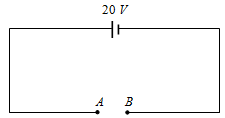
In the shown circuit, what is the potential difference across $A$ and $B$
Range of wavelength of X-rays is:
$^{22}Ne$ nucleus after absorbing energy decays into two α - particles and an unknown nucleus. The unknown nucleus is
In a P-type semi-conductor, germanium is dopped with(a) Gallium (b) Boron(c) Aluminium(d) All of these
       
What should be the angle between two plane mirrors so that whatever be the angle of incidence, the incident ray and the reflected ray from the two mirrors be parallel to each other(a) 60°(b) 90°(c) 120°(d) 175°
       
Direction of force due to magnetic field on a moving charged particle is:
  1. Perpendicular to direction of velocity of charged particle.
  2. Perpendicular to direction of magnetic field.
  3. Parallel to direction of velocity of charged particle.
  4. Parallel to the direction of magnetic field.
Correct statements are.