MCQ
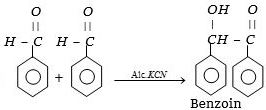
Which of the following compound will react with ethanolic $KCN$
  • A
    Ethane
  • B
    Acetyl chloride
  • C
    Chlorobenzene
  • Benzaldehyde

Answer

Correct option: D.
Benzaldehyde
d
(d) This reaction is called benzoin condensation.

Need a full question paper?

Generate a complete, print-ready paper with questions like this in minutes — across 16+ boards, with answer keys.

Start Generating Free

Similar questions

Which of the following has more unpaired $d$-electrons
The solution from the following with highest depression in freezing point/lowest freezing point is
$\begin{gathered}
  \begin{array}{*{20}{c}}
  {O\,\,\,\,\,\,\,\,\,\,\,\,\,\,\,\,\,\,\,\,\,\,\,\,\,\,\,\,\,\,\,\,\,\,\,\,\,\,\,\,\,\,\,\,\,\,\,\,\,\,\,\,\,\,\,\,\,\,\,\,\,\,\,\,\,\,\,\,\,\,\,\,\,\,} \\ 
  {||\,\,\,\,\,\,\,\,\,\,\,\,\,\,\,\,\,\,\,\,\,\,\,\,\,\,\,\,\,\,\,\,\,\,\,\,\,\,\,\,\,\,\,\,\,\,\,\,\,\,\,\,\,\,\,\,\,\,\,\,\,\,\,\,\,\,\,\,\,\,\,\,\,\,} \\ 
  {C{H_3} - {\text{  }}C - {\text{ }}O - H\xrightarrow{{NaH{{\mathop {CO}\limits^{14} }_3}}}\mathop {(A)}\limits_{(gas)} \xrightarrow[{(ii){H_3}{O^ \oplus }}]{{(i)PhMgBr}}(B)} 
\end{array} \hfill \\
  \begin{array}{*{20}{c}}
  {O\,\,\,\,\,\,\,\,\,\,\,\,\,\,\,\,\,\,\,\,\,\,\,\,\,\,\,\,\,\,\,\,\,\,\,\,\,\,\,\,\,\,\,\,\,\,\,\,\,\,\,\,\,\,\,\,\,\,\,\,\,\,\,\,\,\,\,\,\,\,\,\,\,\,} \\ 
  {||\,\,\,\,\,\,\,\,\,\,\,\,\,\,\,\,\,\,\,\,\,\,\,\,\,\,\,\,\,\,\,\,\,\,\,\,\,\,\,\,\,\,\,\,\,\,\,\,\,\,\,\,\,\,\,\,\,\,\,\,\,\,\,\,\,\,\,\,\,\,\,\,\,\,} \\ 
  {C{H_3} - S - O - H\xrightarrow{{NaH\mathop {C{O_3}}\limits^{14} }}\mathop {(C)}\limits_{(gas)} \xrightarrow[{(ii){H_3}{O^ \oplus }}]{{(i)PhMgBr}}(D)} \\ 
  {||\,\,\,\,\,\,\,\,\,\,\,\,\,\,\,\,\,\,\,\,\,\,\,\,\,\,\,\,\,\,\,\,\,\,\,\,\,\,\,\,\,\,\,\,\,\,\,\,\,\,\,\,\,\,\,\,\,\,\,\,\,\,\,\,\,\,\,\,\,\,\,\,\,\,\,} \\ 
  {O\,\,\,\,\,\,\,\,\,\,\,\,\,\,\,\,\,\,\,\,\,\,\,\,\,\,\,\,\,\,\,\,\,\,\,\,\,\,\,\,\,\,\,\,\,\,\,\,\,\,\,\,\,\,\,\,\,\,\,\,\,\,\,\,\,\,\,\,\,\,\,\,\,\,\,\,} 
\end{array} \hfill \\ 
\end{gathered}$

Product $(B)$ and $(D) $ in the above reaction are
For the reaction ; $2A_{(g)}+ B_{(g)}   \rightleftharpoons  3C_{(g)} + D_{(g)}$ two moles each of $A$ and $B$ were taken into one litre flask. The following must always be true when the system attains equilibrium
The following reaction is described as
Which of the following compounds will react with $NaHC{O_3}$ solution to give sodium salt and carbon dioxide
Which of the following compound will not dissolve in hot mixture of $NaOH$ and $H_2O$ ?
The standard Gibbs energy change in the reaction

${H_2}O\, \rightleftharpoons \,{H^ + } + O{H^ - }$ at $25\,^oC$ is.....$kJ$

Heats of combustion $(\Delta {H^o})$ for $C(s),\,{H_2}(g)$ and $C{H_4}(g)$ are $ - 94,\, - 68$ and $ - 213\,kcal/mol.$ respectively. The value of $\Delta {H^o}$ for the reaction,$C(s) + 2{H_2}(g)\, \to \,C{H_4}(g)$ is .....$kcal$
$IP$  of  $Be$  is higher than

$(a)\,\,B\,\,\,\,\,\,\,\,\,\,(b)\,\,Mg\,\,\,\,\,\,\,\,\,\,\,\,(c)\,\,Li\,\,\,\,\,\,\,\,\,\,\,\,(d)\,\,Al\,\,\,\,\,\,\,\,\,\,\,(e)\,\,K$