MCQ
Which of the following compounds does not react with $NaHSO_3$
  • A
    $C_6H_5CHO$
  • $C_6H_5COCH_3$
  • C
    $CH_3COCH_3$
  • D
    $CH_3CHO$

Answer

Correct option: B.
$C_6H_5COCH_3$
b
Acetophenone $\left( C _6 H _5 COCH _3\right.$ ) does not give addition product with sodium bisulphite $\left( NaHSO _3\right)$ solution. This is because, two bulkier group are attached with the carbonyl carbon. These groups decrease the reactivity of carbonyl carbon.

Need a full question paper?

Generate a complete, print-ready paper with questions like this in minutes — across 16+ boards, with answer keys.

Start Generating Free

Similar questions

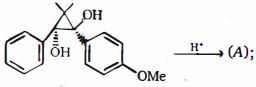
Predict the major product of the given reaction.

Product $(A)$ is

The increase in equivalent conductance of an electrolyte solution with dilution is due to the increase in
Which is heaviest among the following
Given ${E^o}_{A{g^ + }/Ag} = 0.80\,V,\,\,\,{E^o}_{M{g^{2 + }}/Mg} =  - 2.37\,V,$ ${E^o}_{C{u^{2 + }}/Cu} = 0.34\,V,\,\,{E^o}_{H{g^{2 + }}/Hg}\, = 0.79\,V.$

Which of the following statements is correct ?

Which of the following acids, the strongest is
Which of the following will be most reactive for $S_{N_1}$ reaction?
A chemist wants to determine the molecular geometry of the $[CoCl_4]^{2-}$ ion. Which of the following gives the best suggestion for a measurement and for the interpretation of that measurement ?
Compound having highest oxidation state of central atom act as acid lowest one act as basic and intermediete $O.S.$ act as amphoteric. Which one of the following is amphoteric
Why $NH_3$ can’t be dried by $H_2SO_4,\, P_2O_5$ , and $CaCl_2$
The major product of the following reaction is

$\,\begin{array}{*{20}{c}}
{C{H_3} - CH - C{H_2} - CH - C{H_2} - C{H_3}}\\
{\,\,\,\,\,\,\,\,\,\,\,\,\,\,\,\,\,\,\,\,\,\,\,\,\,\,\,\,\,\,|\,\,\,\,\,\,\,\,\,\,\,\,\,\,\,\,\,\,\,\,\,\,\,\,\,\,\,\,\,\,\,\,\,\,\,|\,\,\,\,\,\,\,\,\,\,\,\,\,\,\,\,\,\,\,\,\,\,\,\,\,\,\,\,\,\,\,\,\,\,\,\,\,\,\,\,\,\,\,\,\,\,\,\,\,\,\,\,}\\
{\,\,\,\,\,\,\,\,\,Br\,\,\,\,\,\,\,\,\,\,\,\,\,\,\,\,\,\,\,\,\,\,\,\,\,\,\,\,\,\,\,Br\,\,\,\,\,\,\,\,\,\,\,\,\,\,\,\,\,\,\,\,\,\,\,\,\,\,\,\,\,\,}
\end{array}$ $\xrightarrow[{heat}]{{KOH,\,C{H_3}OH}}$