Question
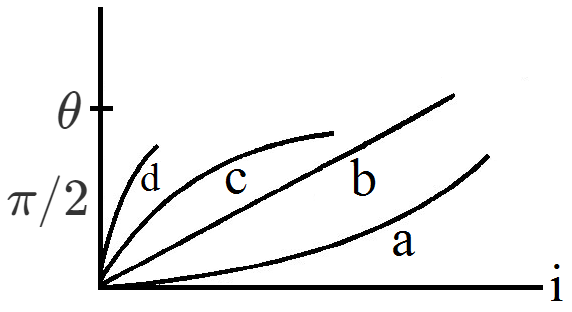
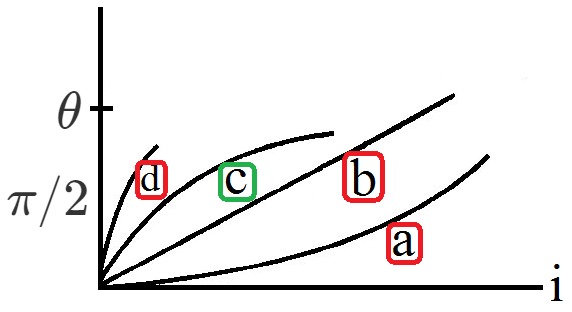
Which of the following four graphs may best represent the current$-$deflection relation in a tangent galvanometer?
Answer


Since i $\propto\tan \theta,$ the only graph that represents this correlation is curve. 

Need a full question paper?

Generate a complete, print-ready paper with questions like this in minutes — across 16+ boards, with answer keys.

Start Generating Free

Similar questions

You stand on a spring scale on the floor of an elevator. Of the following, the scale shows  the highest reading when the elevator
A  solid sphere is in rolling motion. In rolling motion a body possesses translational kinetic energy $(K_t)$ as well as rotational kinetic energy $(K_r)$ simultaneously.  The ratio $K_t : (K_t + K_r)$ for the sphere is
A person sitting in a moving train with his face towards the engine, throws a coin vertically upwards. The coin falls ahead of person. The train:
A wire suspended vertically from one end is stretched by attaching a weight $200 \,N$ to the lower end. The weight stretches the wire by $1 \,mm$. The elastic potential energy gained by the wire is ....... $J$
Two water pipes $P$ and $Q$ having diameters of $2 \times 10^{-2}m$ and $4 \times 10^{-2}$m respectively are joined in series with the main supply line of water. The velocity of water following in pipe $P$ is:
Two wires are made of the same material and have the same volume. The first wire has cross-sectional area $A$ and the second wire has cross-sectional area $3A$. If the length of the first wire is increased by $\Delta l$ on applying a force $F$, how much force is needed to stretch the second wire by the same amount?
$Assertion$ : A body with constant acceleration always moves along a straight line.

$Reason$ : A body with constant acceleration may not speed up.

The diagrams represent the potential energy $U$ of a function of the inter-atomic distance $r.$  Which diagram corresponds to stable molecules found in nature.
Two identical balls are interconnected with a massless and inextensible thread. The system is in gravity free space with the thread just taut. Each ball is imparted a velocity $v$, one towards the other ball and the other perpendicular to the first, at $t = 0$. Then,
There are $100$ divisions on the circular scale of a screw gauge of pitch $1 \mathrm{~mm}$. With no measuring quantity in between the jaws, the zero of the circular scale lies $5$ divisions below the reference line. The diameter of a wire is then measured using this screw gauge. It is found the $4$ linear scale divisions are clearly visible while $60$ divisions on circular scale coincide with the reference line. The diameter of the wire is :