MCQ
Which of the following has minimum freezing point
  • A
    $0.1\,M$ ${K_2}C{r_2}{O_7}$
  • B
    $0.1 \,M$  $N{H_4}Cl$
  • C
    $0.1\,M $ $BaS{O_4}$
  • $0.1\,M $ $A{l_2}{(S{O_4})_3}$

Answer

Correct option: D.
$0.1\,M $ $A{l_2}{(S{O_4})_3}$
d
(d) We know that lowering of freezing point is a colligative property which is directly proportional to the number of particles formed by one mole of compound therefore $0.1\,M$  $A{l_2}{(S{O_4})_3}$ solution will have minimum freezing point.

Need a full question paper?

Generate a complete, print-ready paper with questions like this in minutes — across 16+ boards, with answer keys.

Start Generating Free

Similar questions

Iodine dissolves readily in
$\begin{array}{*{20}{c}}
  {O\,\,\,\,\,\,\,\,\,\,\,\,\,\,\,\,\,\,\,\,\,\,\,\,\,\,\,\,\,\,\,\,\,\,\,\,\,\,\,\,\,\,\,\,\,\,\,\,\,\,\,\,\,\,\,\,\,\,} \\ 
  {||\,\,\,\,\,\,\,\,\,\,\,\,\,\,\,\,\,\,\,\,\,\,\,\,\,\,\,\,\,\,\,\,\,\,\,\,\,\,\,\,\,\,\,\,\,\,\,\,\,\,\,\,\,\,\,\,\,\,\,} \\ 
  {Et - {\text{ }}O - {\text{ }}C - {\text{ }}O - {\text{ }}Et\xrightarrow[{(2){H_3}{O^ \oplus }}]{{\left( 1 \right){\text{ }}C{H_3}MgBr\,\,\left( {excess} \right)}}(A),} 
\end{array}$

 Product $(A)$ is 

Sulphonation of benzoic acid produces mainly
The main function of a catalyst in speeding up a reaction is
The compound with maximum value of van't Hoff factor (i) for complete dissociation of solute in aqueous solution is ;
At high temperature nitrogen combines with calcium carbide $(Ca{C_2})$ to give
The double helical structure of $DNA$ was proposed by
Given below are two statements :

Statement $I :$ The limiting molar conductivity of $\mathrm{KCl}$ (strong electrolyte) is higher compared to that of $\mathrm{CH}_{3} \mathrm{COOH}$ (weak electrolyte).

Statement $II :$ Molar conductivity decreases with decrease in concentration of electrolyte.

In the light of the above statements, choose the most appropriate answer from the options given below:

$224 \,mL$ of $SO _{2( g )}$ at $298 K$ and $1\, atm$ is passed through $100 \,mL$ of $0.1 \,M \,NaOH$ solution. The non-volatile solute produced is dissolved in $36\, g$ of water. The lowering of vapour pressure of solution (assuming the solution is dilute)
$\left( P _{\left( H _{2} O \right)}=24\, mm \right.$ of $\left. Hg \right)$ is $x \times 10^{-2} mm$ of $Hg$ the value of $x$ is ...... .(Integer answer)
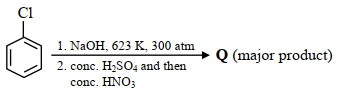
The weight percentage of hydrogen in $Q$, formed in the following reaction sequence, is. . . . 

[Given : Atomic mass of $H =1, C =12, N =14, O =16, S =32, Cl =35$ ]