Question
Which of the following have zero average value in a plane electromagnetic wave?

Answer

  1. Electric field.
  2. Magnetic field.
Explanation:
In a plane electromagnetic wave, the electric and the magnetic fields oscillate sinusoidally. For an electromagnetic wave propagating in the z-direction, the electric and magnetic fields are given by,
$\text{E}_\text{x}=\text{E}_0\sin(\text{kz}-\omega\text{t})$
$\text{B}_\text{y}=\text{B}_0\sin(\text{kz}-\omega\text{t})$
These are sinusoidal functions. Therefore, for a fixed value of z. the average value of the electric and magnetic fields are zero.

Need a full question paper?

Generate a complete, print-ready paper with questions like this in minutes — across 16+ boards, with answer keys.
Start Generating Free

Similar questions

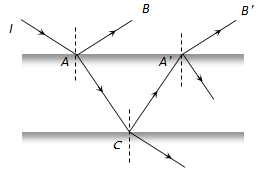
A ray of light of intensity $I$ is incident on a parallel glass$-$slab at a point A as shown in fig. It undergoes partial reflection and refraction. At each reflection $25\%$ of incident energy is reflected. The rays $AB$ and $A'B'$ undergo interference. The ratio $\mathrm{I}_{\max } / \mathrm{I}_{\min }$ is
All of the following statements are correct except(a) The magnification produced by a convex mirror is always less than one(b) A virtual, erect, same-sized image can be obtained using a plane mirror(c) A virtual, erect, magnified image can be formed using a concave mirror(d) A real, inverted, same-sized image can be formed using a convex mirror


If the wavelength of light is $4000 \mathring A ,$ then the number of waves in $1\ mm$ length will be
A double convex lens $\left(\mathrm{R}_1=\mathrm{R}_2=10 \mathrm{~cm}\right)(\mu=1.5)$ having focal length equal to the focal length of a concave mirror. The radius of curvature of the concave mirror is
What is the driving force in a working Electrical Circuit?
Photoelectric emission occurs only when the incident light has a value slightly greater than the minimum value of which of the following:
The SI unit of dipole moment is:
In a series LCR circuit the voltage across resistance, capacitance and inductance is 10V each. If the capacitance is short circuited, the voltage across the inductance will be.
The magnetic flux through a circuit of resistance $R$ changes by an amount $\triangle \varnothing$  in time $\triangle t, $ Then the total quantity of electric charge $Q,$ which passing during this time through any point of the circuit is given by
Least doped region in a transistor(a) Either emitter or collector(b) Base(c) Emitter(d) Collector