MCQ
Which of the following is a polar compound
  • $HCl$
  • B
    ${H_2}Se$
  • C
    $C{H_4}$
  • D
    $HI$

Answer

Correct option: A.
$HCl$
(a) Higher is the difference in electronegativity of two covalently bonded atoms, higher is the polarity. In $HCl$ there is high difference in the electronegativity of $H$ and $Cl$ atom so it is a polar compound.

Need a full question paper?

Generate a complete, print-ready paper with questions like this in minutes — across 16+ boards, with answer keys.

Start Generating Free

Similar questions

The formation of the oxide ion $O^{-2}_{(g)}$ requires first an exothermic and then an endothermic step as shown below 

$O(g) + e^- = O^-(g)$      $\Delta {H_{eg}} =  - 142\,kJ\,mo{l^{ - 1}}$
$O^-(g) + e^- = O^{2-}(g)$    $\Delta {H_{eg}} =  +844\,kJ\,mo{l^{ - 1}}$

This is because

The solubility of $AgCl$ in $0.2\,\,M\,\,NaCl$ solution $({K_{sp}}$ for $AgCl = 1.20 \times {10^{ - 10}})$ is
The $\text{F}-\text{B}-\text{F}$ bond angle in BF3 molecule is:
The product of following reaction is

$\begin{array}{*{20}{c}}
  {C{H_3}\,\,\,\,\,\,\,\,\,\,\,\,\,\,\,} \\ 
  {\,|\,\,\,\,\,\,\,\,\,\,\,\,\,\,\,\,\,\,\,\,\,\,\,} \\ 
  {C{H_3} - C - CH = C{H_2}\,\,\,\,\,} \\ 
  {\,|\,\,\,\,\,\,\,\,\,\,\,\,\,\,\,\,\,\,\,\,\,\,\,} \\ 
  {\,\,\,\,C{H_{3\,\,\,\,\,\,\,\,\,\,\,\,\,\,\,\,\,\,\,\,\,\,\,\,\,\,\,\,\,}}} 
\end{array}\xrightarrow[{(ii)\,NaB{H_4}}]{{(i)\,Hg{{(OAc)}_2};{H_2}O}}$
$IUPAC $ name of $H - \mathop {\mathop {\mathop {\mathop C\limits^| }\limits^H }\limits_| }\limits_H - \mathop {\mathop {\mathop {\mathop C\limits^| }\limits^{Cl} }\limits_| }\limits_H - Cl$ is
Which of the following isomeric structure have lowest energy?
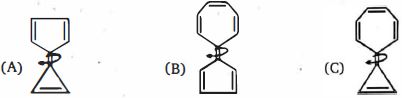
Compare carbon-carbon bond rotation across $A, B,$ and $C$
Which of the following compound has the smallest bond angle $(X - A - X)$ in  each series respectively?
$(A)\, OSF_2$              $OSCl_2$            $OSBr_2$
$(B)\, SbCl_3$              $SbBr_3$             $SbI_3$
$(C)\, PI_3$                  $AsI_3$                $SbI_3$
Hydrogen atoms are held together to form hydrogen molecules by
Which one of the following molecule will have all equal $X- F$ bond length? (where  $X =$ central atom)