- AThe intensity decreases in proportion for the distance squared.
- BThe wavefront is parabolic.
- CThe intensity at the wavelength does not depend on the distance.
- DNone of these.
Explanation:
A point source produces a spherical wavefront that moves in all the directions from the point.
Whereas the intensity at the wavelength is dependent on the distance and it follows the inverse square law. So, the intensity decreases with an increase in the distance from the source.
Generate a complete, print-ready paper with questions like this in minutes — across 16+ boards, with answer keys.
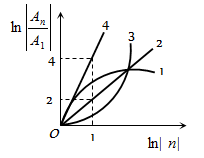
The figure shows a graph between ln
and ln|n|, where
is the area enclosed by the nth orbit in a hydrogen like atom. The correct curve is

|
(a) 4 |
(b) 3 |
(c) 2 |
(d) 1 |
A charged particle moves in a uniform magnetic field. The velocity of the particle at some instant makes an acute angle with the magnetic field. The path of the particle will be
|
(a) A straight line |
(b) A circle |
|
(c) A helix with uniform pitch |
(d) A helix with non-uniform pitch |
X-rays are produced in X-ray tube operating at a given accelerating voltage. The wavelength of the continuous X-rays has values from
| (a) 0 to ∞ |
|
(b) |
|
(c) 0 to |
|
(d) |
The range of wavelength of the visible light is
|
(a) 10 Å to 100 Å |
(b) 4,000 Å to 8,000 Å |
(c) 8,000 Å to 10,000 Å |
(d) 10,000 Å to 15,000 Å |
The resistance of a wire is R. If the length of the wire is doubled by stretching, then the new resistance will be
|
(a) 2R |
(b) 4R |
(c) R |
(d) |
An oil drop having charge 2e is kept stationary between two parallel horizontal plates 2.0 cm apart when a potential difference of 12000 volts is applied between them. If the density of oil is 900 kg/m3, the radius of the drop will be
|
(a) 2.0 |
(b) 1.7 |
(c) 1.4 |
(d) 1.1 |
When a wire loop is rotated in a magnetic field, the direction of induced e.m.f. changes once in each
|
(a) |
(b) |
(c) 1 revolution |
(d) 2 revolution |