MCQ
Which of the following is correct statement:
  • Equipotential lines are always perpendicular to the electric field.
  • B
    Work done for moving a charge along the conducting surface (closed and containing charge) very close to it may be negative or positive.
  • C
    Electric field may cross each other.
  • D
    None of the above.

Answer

Correct option: A.
Equipotential lines are always perpendicular to the electric field.

There is no potential gradient along any direction parallel to the surface, and no electric field is parallel with the surface, This means electric field are always at right angle to the equipotential surface.

Need a full question paper?

Generate a complete, print-ready paper with questions like this in minutes — across 16+ boards, with answer keys.

Start Generating Free

Similar questions

In extrinsic semiconductors
An air capacitor of capacity C = 10μF is connected to a constant voltage battery of 12 V. Now the space between the plates is filled with a liquid of dielectric constant 5. The charge that flows now from battery to the capacitor is
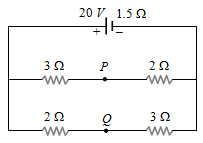
If in the circuit shown below, the internal resistance of the battery is 1.5 W and $V_P$ and $V_Q$ are the potentials at P and Q respectively, what is the potential difference between the points P and Q
A square object of area $100\,sq.\,cm$ is placed perpendicular to the principle axis of a concave mirror. If the lateral magnification of the mirror, for the above object position, is $0.4,$ then the area of the image will be......$\,sq.\,cm$
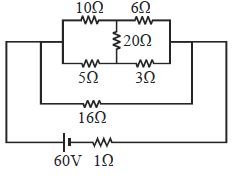
The current from the cell for the given circuit is ................ $\mathrm{A}$
Paramagnetic substances:

$A$. align themselves along the directions of external magnetic field.

$B$. attract strongly towards external magnetic field.

$C$. has susceptibility little more than zero.

$D$. move from a region of strong magnetic field to weak magnetic field.

Choose the most appropriate answer from the options given below:

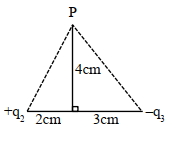
If the net electric field at point $\mathrm{P}$ along $\mathrm{Y}$ axis is zero, then the ratio of $\left|\frac{q_2}{q_3}\right|$ is $\frac{8}{5 \sqrt{x}}$, where $\mathrm{x}=$. . . . . .
Which can pass through $20 \,cm$ thickness of the steel
A solenoid of 1.5 metre length and 4.0 cm diameter posses 10 turn per cm. A current of 5 ampere is flowing through it. The magnetic induction at axis inside the solenoid is
Charge $q$ is distributed on two spheres of radii $r_1$ and $r_2$ in such a way that they have the same surface density. Ratio in their potential :