MCQ
Which of the following is correct
  • A
    $\frac{{{t_{3/4}}}}{{{t_{1/2}}}} = 3$ [first order reaction]
  • B
    $\frac{{{t_{7/8}}}}{{{t_{1/2}}}} = 3$ [second order reaction]
  • $\frac{{{t_{7/8}}}}{{{t_{1/2}}}} = \frac{7}{4}$ [zero order reaction]
  • D
    $\frac{{{t_{15/16}}}}{{{t_{1/2}}}} = 15$ [first order reaction]
Answer

Correct option: C.
$\frac{{{t_{7/8}}}}{{{t_{1/2}}}} = \frac{7}{4}$ [zero order reaction]
c
$x = kt$ for zero order $ \Rightarrow \frac{{{t_{7/8}}}}{{{t_{1/2}}}} = \frac{7}{4}$

Need a full question paper?

Generate a complete, print-ready paper with questions like this in minutes — across 16+ boards, with answer keys.

Start Generating Free

Similar questions

Decarboxylation of all six possible forms of diaminobenzoic acids $C _{6} H _{3}\left( NH _{2}\right)_{2} COOH$ yields three products $A , B$ and $C$. Three acids give a product $'A',$ two acids gives a product $'B'$ and one acid give a product $'C'.$ The melting point of product $'C'$ is .....$^{\circ} C$.
$A + 2B \to 3C$ for the chemical reaction
Among the following molecule highest dipole moment is
For the electrochemical cell, $M|{M^ + }||{X^ - }|X,$ ${E^o}({M^ + }/M)$ $= 0.44\, V$  and ${E^o}(X/{X^ - })$ $= 0.33\,V$. From this data one can deduce that
Then during electrolysis of a solution of $AgNO_3$, $ 9650$  coulombs of charge pass through the electroplating bath, the mass of silver deposited in the cathode will be .............. $\mathrm{g}$
Equivalent mass of oxidizing agent in the reaction is $SO_2 + 2H_2S \to 3S + 2H_2O$ is
Which of the following will have geometrical isomers
The oxide which cannot act as a reducing agent is
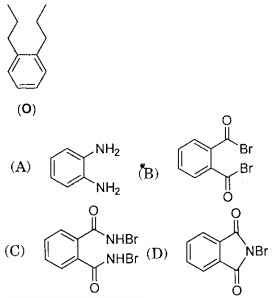
Treatment of compound $O$ with $KMnO_4 / \mathrm{H}^{+}$gave $P$, which on heating with ammonia gave $Q$. The compound $Q$ on treatment with $Br_2 / NaOH$ produced $R$. On strong heating, $Q$ gave $S$, which on further treatment with ethyl $2$-bromopropanoate in the presence of $KOH$ followed by acidification, gave a compound $T$.

(image)

($1$) The compound $R$ is

(image)

($2$) The compound $T$ is

($A$) glycine

($B$) alanine

($C$) valine

($D$) serine

Given the answer question ($1$) and ($2$) 

In dimer of phosphorus pentaoxide, in what order number of $P -$ $P , P = O \& P - O - P$ bonds are there?