MCQ
Which of the following is neutral oxide ?
  • A
    $SnO$
  • B
    $PbO$
  • C
    $PbO_2$
  • $N_2O$

Answer

Correct option: D.
$N_2O$
d
$N_2O$

Need a full question paper?

Generate a complete, print-ready paper with questions like this in minutes — across 16+ boards, with answer keys.
Start Generating Free

Similar questions

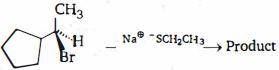
Consider the following reaction and select the, best choice that represents the reaction
Given below are two statements: one is labelled as Assertion $A$ and the other is labelled as Reason $R.$

Assertion $A:$ $3.1500\,g$ of hydrated oxalic acid dissolved in water to make $250.0\,mL$ solution will result in $0.1\,M$ oxalic acid solution.

Reason $R:$ Molar mass of hydrated oxalic acid is $126\,g\,mol ^{-1}$.

In the light of the above statements, chose the correct answer from the options given below:

$[ A ] Reactant \quad \rightarrow$ $[ B ]Product$ If formation of compound $[B]$ follows the first order of kinetics and after 70 minutes the concentration of $[ A ]$ was found to be half of its initial concentration. Then the rate constant of the reaction is $x \times 10^{-6} s ^{-1}$. The value of $x$ is $......$ (Nearest Integer)
Which statement about the following equilibrium is true ?
$a. NH_3 > PH_3 > AsH_3$ Thermal stability

$b. NH_3 < PH_3 < AsH_3$ Reducing power

$c. NI_3 > NBr_3 > NCl_3$ Lewis basic character

$d. N_2O_5 > P_2O_5 > As_2O_5$ Acidic character

Correct order is

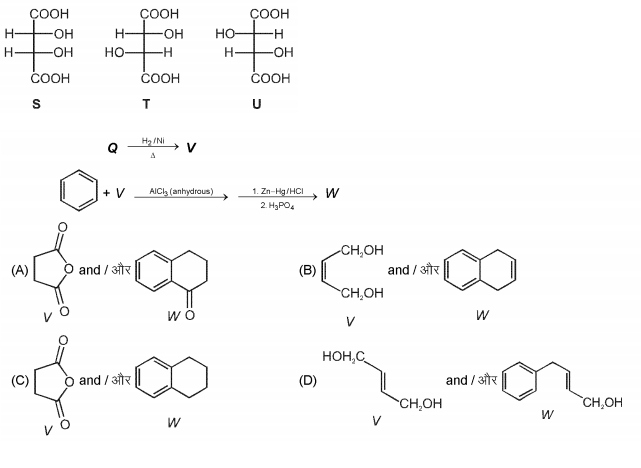
$P$ and $Q$ are isomers of dicarboxylic acid $C _4 H _4 O _4$. Both decolorize $Br _2 / H _2 O$. On heating, $P$ forms the cyclic anhydride.

Upon treatment with dilute alkaline $KMnO _4, P$ as well as $Q$ could produce one or more than one from $S , T$ and $U$.$Image$

$1.$ Compounds formed form $P$ and $Q$ are, respectively

$(A)$ Optically active $S$ and optically active pair $(T, U)$

$(B)$ Optically inactive $S$ and optically inactive pair $(T, U)$

$(C)$ Optically active pair $(T, U)$ and optically active $S$

$(D)$ Optically inactive pair $(T, U)$ and optically inactive $S$

$2.$ In the following reaction sequences $V$ and $W$ are respectively :$Image$

mcq $Image$

Give the answer question $1$ and $2.$
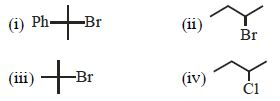
Arrange in order of increasing $S_N1$ reaction rate.
Which of the following xenon compound has the same number of lone pairs as in $I_3^-$ ?
Consider the hypothetical situation where the azimuthal quantum number, $l$, takes values $0$ , $1,2, \ldots \ldots n+1,$ where $n$ is the principal quantum number. Then, the element with atomic number
A mixture has $18\,g$  water and $414\,g$  ethanol. The mole fraction of water in mixture is (assume ideal behaviour of the mixture)