MCQ
Which of the following is not true about the total lunar eclipse?
  • A lunar eclipse can occur on a new moon and full moon day
  • B
    The lunar eclipse would occur roughly every month, if the orbits of earth and moon were perfectly coplanar
  • C
    The moon appears red during the eclipse because the blue light is absorbed in earth's atmosphere and red is transmitted
  • D
    A lunar eclipse can occur only on a full moon day
Answer

Correct option: A.
A lunar eclipse can occur on a new moon and full moon day
a
(a)

A lunar eclipse occurs only on a full moon day.

So, option $(a)$ is incorrect.

Need a full question paper?

Generate a complete, print-ready paper with questions like this in minutes — across 16+ boards, with answer keys.

Start Generating Free

Similar questions

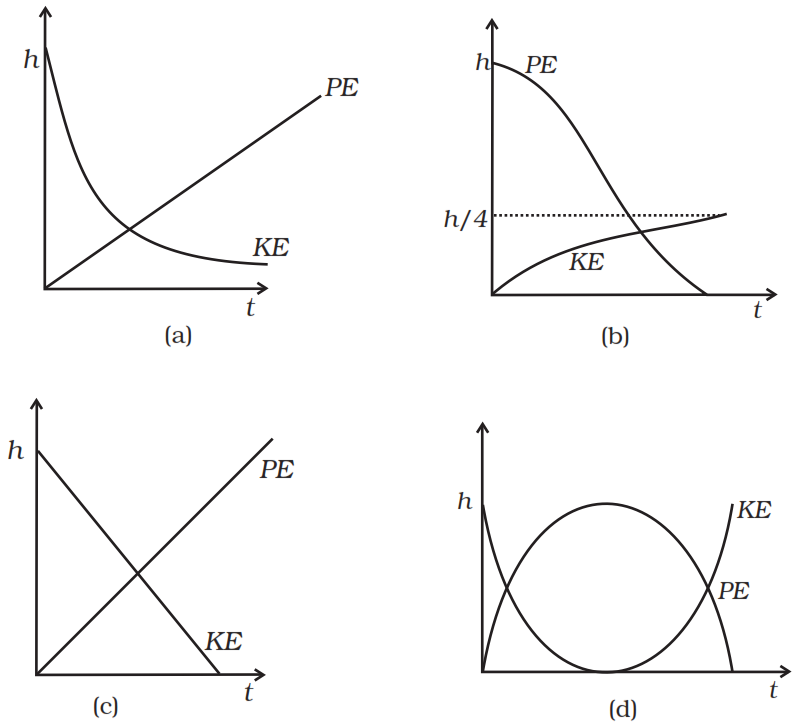
A raindrop falling from a height h above ground, attains a near terminal velocity when it has fallen through a height (3/4)h. Which of the diagrams shown in correctly shows the change in kinetic and potential energy of the drop during its fall up to the ground?
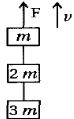
Three blocks with masses $m, 2m $ and $3 m$ are connected by strings, as shown in the figure. After an upward force $F$ is applied on block $m,$ the masses move upward at constant speed $v.$ What is the net force on the block of mass $2\ m\ ?\, (g$ is the acceleration due to gravity$)$
The acceleration of a moving object can be determined by:
When air is filled in the balloon, the pressure and volume both increases while temperature does not change. Here Boyle's law is not obeyed because
A particle moves so that its position vector is given by $\overrightarrow {\;r} = cos\omega t\,\hat x + sin\omega t\,\hat y$ , where $\omega$ is a constant.  Which of the following is true?  
A tank with a small hole at the bottom has been filled with water and kerosene (specific gravity $0.8$). The height of water is $3\,m$ and that of kerosene $2\,m$. When the hole is opened the velocity of fluid coming out from it is nearly ........ $ms^{-1}$ .(take $g\, = 10\, m s^{-2}$ and density of water $= 10^3\, kg\, m^{-3}$)
The rate of loss of heat depends on:
Two spheres of the same material have radii $1\  m$ and $4\  m$ and temperatures $4000\  K$ and $2000\  K$ respectively. The ratio of the energy radiated per second by the first sphere to that by the second is
Which pair do not have equal dimensions?
$A$ solid sphere with a velocity (of centre of mass) $v$ and angular velocity $\omega$ is gently placed on a rough horizontal surface. The frictional force on the sphere: