MCQ
Which of the following is smallest unit
  • A
    Millimetre
  • B
    Angstrom
  • Fermi
  • D
    Metre

Answer

Correct option: C.
Fermi
c
(c) $1\,{\rm{fermi}} = {\rm{1}}{{\rm{0}}^{{\rm{ - 15}}}}metre$

Need a full question paper?

Generate a complete, print-ready paper with questions like this in minutes — across 16+ boards, with answer keys.
Start Generating Free

Similar questions

A projectile is thrown in the upward direction making an angle of $60^o $ with the horizontal direction with a velocity of $147\ ms^{-1}$ . Then the time after which its inclination with the horizontal is $45^o $ , is    ......... $\sec$
Two forces of magnitude $P$ & $Q$ acting at a point have resultant $R$. The resolved  part of $R$ in the direction of $P$ is of magnitude $Q$. Angle between the forces is :
If the resultant of three forces $\vec{\text{F}}_1=\text{p}\hat{\text{i}}+3\hat{\text{j}}-\hat{\text{k}},\ \vec{\text{F}}_2=-5\hat{\text{i}}+2\hat{\text{k}},$ and $\vec{\text{F}}_3=6\hat{\text{i}}-\hat{\text{k}}$ acting on a particle has a magnitude equal to 5 units, then the value of p is:
A body of mass $0.5\, kg$ travels on straight line path with velocity $v =\left(3 x ^{2}+4\right) m / s$. The net workdone by the force during its displacement from $x =0$ to $x =2\, m$ is$.......J$
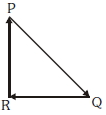
A particle moving with velocity $\overrightarrow{\mathrm{V}}$ is acted by three forces shown by the vector triangle $PQR$. The velocity of the particle will 
$A$ uniform disc is rolling on a horizontal surface. At a certain instant $B$ is the point of contact and $A$ is at height $2R$ from ground, where $R$ is radius of disc.
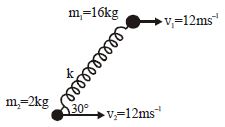
Two particles with mass $m_1$ = $16\ kg$ and $m_2$ = $2\ kg$ slide as unit with a common velocity of $12\ ms^{-1}$ on a level frictionless surface. Between them is a compressed massless spring with spring constant $k$ = $100\ Nm^{-1}$ . The spring, originally compressed by $25\ cm$ , is suddenly released, sending the two masses, which are connected to the spring, flying apart from each other. The orientation of the spring w.r.t. the initial velocity is shown in diagram. What is the relative velocity of separation in $ms^{-1}$ , after the particles lose contact? ................$m/s$
What is the velocity of a metallic ball of radius r falling in a tank of liquid at the instant when its acceleration is one half that of a freely falling body? (The densities of metal and of liquid are $\rho$ and $\sigma$ respectively and of viscosity of liquid is $\eta$)
A body executing simple harmonic motion has a maximum acceleration equal to $ 24\,metres/se{c^2} $ and maximum velocity equal to $ 16\;metres/sec $. The amplitude of the simple harmonic motion is
Two particles are simultaneously projected in opposite directions horizontally from a given point in space, where gravity $g$ is uniform. If $u_1$ and $u_2$ be their initial speeds, then the time $t$ after which their velocities are mutually perpendicular is given by