MCQ
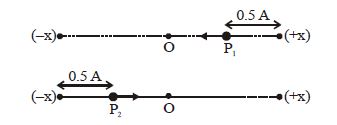
A body executing simple harmonic motion has a maximum acceleration equal to $ 24\,metres/se{c^2} $ and maximum velocity equal to $ 16\;metres/sec $. The amplitude of the simple harmonic motion is
  • $\frac{{32}}{3}\,metres$
  • B
    $\frac{3}{{32}}\,metres$
  • C
    $\frac{{1024}}{9}\,metres$
  • D
    $\frac{{64}}{9}\,metres$

Answer

Correct option: A.
$\frac{{32}}{3}\,metres$
a
(a) Maximum velocity $ = a\omega = 16$ 

Maximum acceleration $ = {\omega ^2}a = 24$ 

$ \Rightarrow a = \frac{{{{(a\omega )}^2}}}{{{\omega ^2}a}} = \frac{{16 \times 16}}{{24}} = \frac{{32}}{3}m$

Need a full question paper?

Generate a complete, print-ready paper with questions like this in minutes — across 16+ boards, with answer keys.

Start Generating Free

Similar questions

A particle of mass $m$ is tied to one end of $a$ string of length $l$. The particle is held horizontal with the string $mg$ taut. It is then projected upward with $a$ velocity $u$. The tension in the string is $\frac{{mg}}{2}$ when it is inclined at an angle $30^o$ to the horizontal. The value of $u$ is
A satellite of mass m is at a distance of $'a'$ from a star of mass $M.$ The speed of the satellite is $u.$ Suppose the law of universal gravity is $F=-G\frac{Mm}{r^{2.1}}$ instead of $F=-G\frac{Mm}{r^{2}}$ find the speed of the satellite when it is at $a$ distance $b$ from the star.
A pendulum suspended from the ceiling of a train has a period $T$ when the train is at rest. When the train travels same distance per unit time, the period of oscillation is
A vessel contains $14\,g$ of nitrogen gas at a temperature of $27^{\circ}\,C$. The amount of heat to be transferred to the gap to double the r.m.s. speed of its molecules will be $......J$ $\left(\right.$ Take $R =8.32\,J\,mol ^{-1} k ^{-1}$ )
The phase of a particle performing simple harmonic $\frac{\pi}{2}$ while its:
Two bodies performing $S.H.M.$ have same amplitude and frequency. Their phases at a certain instant are as shown in the figure. The phase difference between them is
As a body performs $S.H.M.$, its potential energy $U.$ varies with time as indicated in
At some point the gravitational potential and also the gravitational field due to earth is zero. The point is
A positively charged particle projected towards east is deflected towards north by a magnetic field. The field may be:
  1. Towards west.
  2. Towards south.
  3. Upward.
  4. Downward.
A boy playing on the roof of a $10\, m$ high building throws a ball with a speed of $10\,m/s$ at an angle of $30^o$ with the horizontal. How far from the throwing point will the ball be at the height of $10\, m$ from the ground ?  $\left[ {g = 10\,m/{s^2},\sin \,{{30}^o} = \frac{1}{2},\cos \,{{30}^o} = \frac{{\sqrt 3 }}{2}} \right]$