MCQ
Which of the following is the most suitable material for making permanent magnet?
- ASteel.
- BSoft iron.
- CCopper.
- DNickel.
Generate a complete, print-ready paper with questions like this in minutes — across 16+ boards, with answer keys.
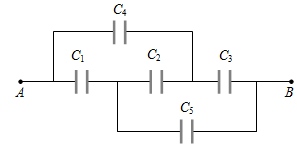
In the given figure the capacitors  have a capacitance 4mF each if the capacitor
  has a capacitance 10mF, then effective capacitance between A and B will be
|
(a) 2mF |
(b) 4mF |
(c) 6mF |
(d) 8mF |
Hydrogen (H), deuterium (D), singly ionized helium ( and doubly ionized lithium (Li) all have one electron around the nucleus. Consider n =2 to n = 1 transition. The wavelengths of emitted radiations are
  and
and  respectively. Then approximately
|
(a) |
(b) 4 |
|
(c) |
(d) |
A current I is passed for a time t through a number of voltameters. If m is the mass of a substance deposited on an electrode and z is its electrochemical equivalent, then
|
(a) |
(b) |
|
(c) |
(d) |
In  nucleus, there are
|
(a) 138 protons and 88 neutrons |
(b) 138 neutrons and 88 protons |
|
(c) 226 protons and 88 electrons |
(d) 226 neutrons and 138 electrons |
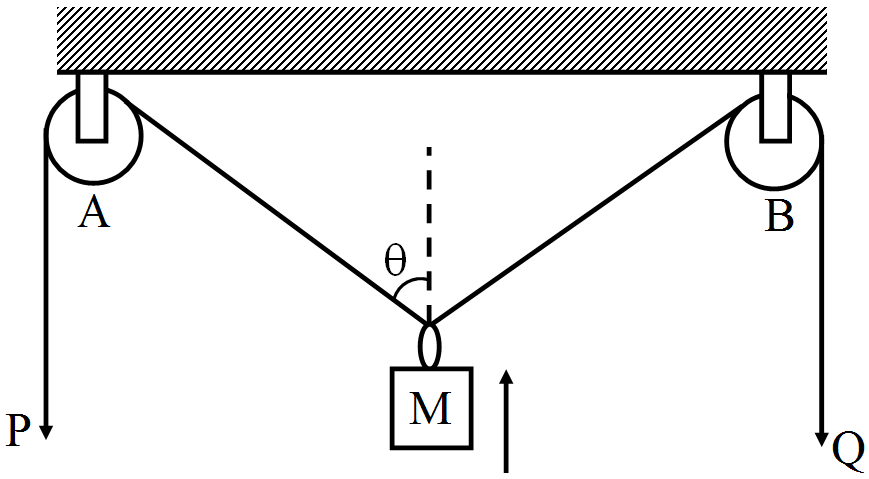
$2\text{u}\cos\theta$
$\frac{\text{u}}{\cos\theta}$
$\frac{\text{2u}}{\cos\theta}$
$\text{u}\cos\theta$
What will be the angle of diffracting for the first minimum due to Fraunhoffer diffraction with sources of light of wave length 550 nm and slit of width 0.55 mm
|
(a) 0.001 rad |
(b) 0.01 rad |
(c) 1 rad |
(d) 0.1 rad |
A convex lens is used to form real image of an object on a screen. It is observed that even when the positions of the object and that screen are fixed there are two positions of the lens to form real images. If the heights of the images are 4 cm and 9 cm respectively, the height of the object is
|
(a) 2.25 cm |
(b) 6.00 cm |
(c) 6.50 cm |
(d) 36.00 cm |






