MCQ
Which of the following odd $e^-$ species is planar ? 
  • $CH_3^+$
  • B
    $\dot C lO_3$
  • C
    $\dot C F_3$
  • D
    None of these

Answer

Correct option: A.
$CH_3^+$
(A) $CH_3^+$ is planar but is not an odd $e^-$ species
(B) $\dot C lO_3$ is non-planar and $sp^3$ hybridised
(C) $\dot C F_3$ is non-planar and $sp^3$ hybridised

Need a full question paper?

Generate a complete, print-ready paper with questions like this in minutes — across 16+ boards, with answer keys.

Start Generating Free

Similar questions

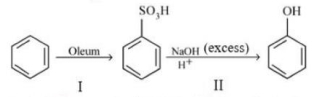
In the following reaction

The $\%$ yield for reaction $I$ is $60 \%$ and that of reaction II is $50 \%$. The overall yield of the complete reaction is $..........\%$ [nearest integer]
The work done during reversible isothermal expansion of one mole of hydrogen gas at $25^{\circ} \mathrm{C}$ from pressure of $20 \mathrm{atmosphere} \mathrm{to} 10 \mathrm{atmosphere}$ is

(Given $R=2.0 \mathrm{cal} \mathrm{K}^{-1} \mathrm{~mol}^{-1}$ )

The molarity of the solution prepared by dissolving $6.3\, \mathrm{~g}$ of oxalic acid $\left(\mathrm{H}_{2} \mathrm{C}_{2} \mathrm{O}_{4} \cdot 2 \mathrm{H}_{2} \mathrm{O}\right)$ in $250\, \mathrm{~mL}$ of water in $\operatorname{mol} \mathrm{L}^{-1}$ is $\mathrm{x} \times 10^{-2} .$ The value of $\mathrm{x}$ is ..... . (Nearest integer)

[Atomic mass : $\mathrm{H}: 1.0, \mathrm{C}: 12.0, \mathrm{O}: 16.0]$

For independent process at $300\,K$.

Process $\Delta H / kJ\,mol ^{-1}$ $\Delta S / J K^{-1}$
$A$ $-25$ $-80$
$B$ $-22$ $40$
$C$ $25$ $-50$
$D$ $22$ $20$

The number of non-spontaneous process from the following is $.....$

Glycerol is used in the manufacture of
The standard enthalpies of formation of $CO _2( g ), H _2 O ( l )$ and glucose$(s)$ at $25^{\circ} C$ are $-400 \ kJ / mol ,-300 \ kJ / mol$ and $-1300 \ kJ / mol$, respectively. The standard enthalpy of combustion per gram of glucose at $25^{\circ} C$ is
Bleaching powder is correctly represented as
Lucas reagent is
Assign $A, B, C, D$ from given type of reaction. $NaN{O_3} + {H_2}S{O_4}\left( {conc.} \right)\xrightarrow{{Hot}}N{a_2}S{O_4} + N{O_2} \uparrow  + {O_2} \uparrow $
Elimination of bromine from $2-$bromobutane results in the formation of