MCQ
Which of the following oxide is amphoteric ?
  • $SnO_2$
  • B
    $CaO$
  • C
    $SiO_2$
  • D
    $CO_2$

Answer

Correct option: A.
$SnO_2$
a
$\mathrm{SnO}_{2}$ react with acid as well base

So amphoteric

$\mathrm{SnO}_{2}+4 \mathrm{HCl} \longrightarrow \mathrm{SnCl}_{4}+2 \mathrm{H}_{2} \mathrm{O}$

$\mathrm{SnO}_{2}+2 \mathrm{NaOH} \longrightarrow \mathrm{Na}_{2} \mathrm{SnO}_{3}+\mathrm{H}_{2} \mathrm{O}$

Need a full question paper?

Generate a complete, print-ready paper with questions like this in minutes — across 16+ boards, with answer keys.

Start Generating Free

Similar questions

A chemical reaction: $A + B \rightarrow AB , \,B$ is acting as limiting reagent then choose the correct option. The limiting reagent is :
Which of the following heat of reaction expresses the bond energy of $HCl$
${H_2}(g) + \frac{1}{2}{O_2}(g)\,\, \to \,\,{H_2}O(l)$; $\Delta H$ at $ 298 \,K = -285.8\, kJ$ The molar enthalpy of vaporisation of water at $ 1 $ $atm$ and ${25\,^o}C$ is $44\, kJ. $ The standard enthalpy of formation of  $1$  mole of water vapour at ${25\,^o}C$ is.......$kJ$
When $2-$ butyne is treated with $H_2/$ Lindlar's catalyst, compound $X$ is produced as the major product and when treated with $Na/liq.$ $NH_3$ it produces $Y$ as the major product. Which of the following statements is correct?
The minimum volume of water required to dissolve $0.1\,g$ lead $(II)$ chloride to get a saturated solution ($K_{SP}$ of $PbCl_2 = 3.2 \times 10^{-8}$; atomic mass of $Pb= 207\, u$) is......$L$
One mole of gas absorbs $200\,J$ of heat at constant volume then its temperature rises from $298\,K$ to $308\,K$. Change in internal energy will be....$J$
According to Bronsted-Lowry concept, the correct order of relative strength of bases follows the order
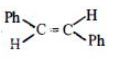
The reagent needed for converting

$Ph - C \equiv C - Ph \to $ 

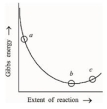
Consider the graph of $G i b b s$ free energy $G$ vs Extent of reaction. The number of statement/s from the following which are true with respect to points $(a), (b)$ and $(c)$ is $.................$

$A.$Reaction is spontaneous at $(a)$ and $(b)$

$B.$Reaction is at equilibrium at point $(b)$ and nonspontaneous at point $(c)$

$C.$Reaction is spontaneous at $(a)$ and nonspontaneous at $(c)$

$D.$Reaction is non-spontaneous at $(a)$ and $(b)$
Identify 'X' in the following sequence of reaction $\text{CH}_3-\text{CH}-\text{CH}-\text{CH}_2-\text{CH}_2-\text{CH}_3\xrightarrow[(\text{ii})\ \text{Na in liq. NH}_3]{(\text{i})\ \text{NaNH}_2}\text{X}$