MCQ
Which of the following ratios express pressure?
  • A
    $\frac{\text{Force}}{\text{Area}}.$
  • B
    $\frac{\text{Energy}}{\text{Volume}}.$
  • C
    $\frac{\text{Energy}}{\text{Area}}.$
  • D
    $\frac{\text{Force}}{\text{Volume}}.$

Answer

  1. $\frac{\text{Force}}{\text{ Area}}.$

  2. $\frac{\text{Energy}}{\text{Volume}}.$

Explanation:

Let us first express the relation of pressure with other physical quantities one by one with the help of dimensional analysis.

We know that pressure,

  1. $\frac{\text{Force}}{\text{Area}}=\frac{[\text{MLT}^{-2}]}{[\text{L}^2]}=[\text{ML}^{-1}\text{T}^{-2}]$

So, this ratio express pressure (In fact this ratio actually represents pressure).

  1. $\frac{\text{Energy}}{\text{Area}}=\frac{[\text{ML}^{2}\text{T}^{-2}]}{[\text{L}^2]}=[\text{MT}^{-2}]$

Dimensions of this ratio are not same as pressure, so this ratio does not express pressure.

  1. $\frac{\text{Energy}}{\text{Volume}}=\frac{[\text{ML}^{2}\text{T}^{-2}]}{[\text{L}^3]}=[\text{ML}^{-1}\text{T}^{-2}]$

Dimensions of this ratio is the same as pressure, so this ratio also express pressure.

  1. $\frac{\text{Force}}{\text{Volume}}=\frac{[\text{ML}\text{T}^{-2}]}{[\text{L}^3]}=[\text{ML}^{-2}\text{T}^{-2}]$

Dimensions of this ratio are not same as pressure, so this ratio does not express pressure.

Need a full question paper?

Generate a complete, print-ready paper with questions like this in minutes — across 16+ boards, with answer keys.
Start Generating Free

Similar questions

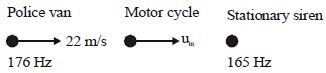
A police van, moving at $22\, m/s$ , chases a motor-cyclist. The police man sounds horn at $176\, Hz$ , while both of them move towards a stationary siren of frequency $165\, Hz$ as shown in the figure. If the motor-cyclist does not observe any beats, his speed must be .... $m/s$ (take the speed of sound $= 330\, m/s$ )
Two like parallel forces $20 \,N$ and $30 \,N$ act at the ends $A$ and $B$ of a rod $1.5 \,m$ long. The resultant of the forces will act at the point ........
The trajectory of projectile, projected from the ground is given by $y=x-\frac{x^2}{20}$. Where $x$ and $y$ are measured in meter. The maximum height attained by the projectile will be $...........\,m$
A sphere cannot roll on:
  1. A smooth horizontal surface.
  2. A smooth inclined surface.
  3. A rough horizontal surface.
  4. A rough inclined surface.
A cubical block of side $'a'$ and density $'\rho '$ slides over a fixed inclined plane with constant velocity $'v'$ . There is a thin film of viscous fluid of thickness $'t'$ between the plane and the block. Then the coefficient of viscosity of the thin film will be
Two forces $P$ and $Q$, of magnitude $2F$ and $3F$, respectively, are at an angle $\theta $ with each other. If the force $Q$ is doubled, then their resultant also gets doubled. Then, the angle $\theta $ is ....... $^o$
A steel ball of radius $2\, cm$ is at rest on a frictionless surface. Another ball of radius $4\,cm$ moving at a velocity of $81 \,cm/sec$ collides elastically with first ball. After collision the smaller ball moves with speed of ............. $\mathrm{cm} / \mathrm{sec}$
A cube is resting on an inclined plane. What must be the value of coefficient of friction between cube and plane so that cube topples before sliding
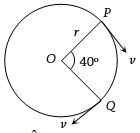
A particle is moving on a circular path of radius $r$ with uniform velocity $v$. The change in velocity when the particle moves from $P$ to $Q$ is $(\angle POQ = 40^\circ )$
A linear harmonic oscillator of force constant $2 \times 10^6\,Nm^{-1}$ and amplitude $0.01\, m$ has a total mechanical energy of $160\, J.$ Its