MCQ
Which of the following represents uniformly accelerated motion?
  • A
    $x=\sqrt{\frac{t+a}{b}}$
  • B
    $x=\frac{t+a}{b}$
  • $t=\sqrt{\frac{x+a}{b}}$
  • D
    $x=\sqrt{t+a}$

Answer

Correct option: C.
$t=\sqrt{\frac{x+a}{b}}$
c
(c)

$t=\sqrt{\frac{x+a}{b}}$

or

$(x+a) =b t^2$

$x =-a+b t^2$

Comparing this equation with general equation of uniformly accelerated motion, $s=s_i+u t+\frac{1}{2} a t^2$

Need a full question paper?

Generate a complete, print-ready paper with questions like this in minutes — across 16+ boards, with answer keys.
Start Generating Free

Similar questions

Identify the pair of physical quantities which have different dimensions 
Two long coaxial and conducting cylinders of radius $a$ and $b$ are separated by a material of conductivity $\sigma$ and a constant potential difference $V$ is maintained between them, by a battery. Then the current, per unit length of the cylinder flowing from one cylinder to the other is -
Identify the solar cell characteristics from the following options.
Absorption of $X-$ ray is maximum in which of the following different sheets
A body of mass $m$ is taken to the bottom of a deep mine. Then
In a certain region of space, variation of potential with distance from origin as we move along $x$-axis is given by $V=8 x^2+2$, where $x$ is the $x$-coordinate of a point in space. The magnitude of electric field at a point $(-4,0)$ is .......... $V / m$
A $5$ watt source emits monochromatic light of wavelength $5000\; \mathring A$. When placed $0.5\; m$ away, it liberates photoelectrons from a photosensitive metallic surface. When the source is moved to a distance of $1.0\;m$, the number of photo electrons liberated will
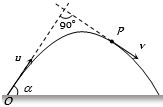
A body is projected with velocity $u$ making an angle $\alpha$ with the horizontal. Its velocity when it is perpendicular to the initial velocity vector $u$ is
A circular disc reaches from top to bottom of an inclined plane of length $l$. When it slips down the plane, if takes $\mathrm{t} \mathrm{s}$. When it rolls down the plane then it takes $\left(\frac{\alpha}{2}\right)^{1 / 2} \mathrm{t} s$, where $\alpha$ is. . . . . . . .  
A circular coil having $200$ turns, $2.5 \times 10^{-4} \mathrm{~m}^2$ area and carrying $100 \mu \mathrm{A}$ current is placed in a uniform magnetic field of $1 \mathrm{~T}$. Initially the magnetic dipole moment $(\vec{M})$ was directed along $\vec{B}$. Amount of work, required to rotate the coil through $90^{\circ}$ from its initial orientation such that $\overrightarrow{\mathrm{M}}$ becomes perpendicular to $\vec{B}$, is. . . . $\mu \mathrm{J}$.