MCQ
Which of the following solid salt on heating with solid $K_2Cr_2O_7$ and conc. $H_2SO_4$ orange red vapours are evolved which tum aquous $NaOH$ solution yellow ?
  • A
    $NaBr$
  • $NaCl$
  • C
    $NaNO_3$
  • D
    $NaI$

Answer

Correct option: B.
$NaCl$
b
$NaC{l_{\left( s \right)}} + {K_2}C{r_2}{O_7}_{\left( s \right)} + {H_2}S{O_4}$ $\left( {{\text{few drop}}} \right)\xrightarrow[{reaction}]{{Non - redox}}$ $\mathop {Cr{O_2}C{l_2}}\limits_{\left( {orange{\kern 1pt} red{\kern 1pt} vapours} \right)} {\mkern 1mu}  \uparrow  + HO$

$Cr{O_2}C{l_2} + OH_{\left( {aq} \right)}^ - $ $\to $  $\mathop {CrO_{4\left( {aq.} \right)}^{2 - }}\limits_{Yellow{\kern 1pt} solution} {\mkern 1mu}  + C{l^ - } + 2{H_2}O$

Need a full question paper?

Generate a complete, print-ready paper with questions like this in minutes — across 16+ boards, with answer keys.

Start Generating Free

Similar questions

Assertion : The boiling points of aldehydes and ketones are higher than hydrocarbons and ethers of comparable molecular masses.
Reason : There is a weak molecular association in aldehydes and ketones arising out of the dipole-dipole interactions
Catalyst $A$ reduces the activation energy for a reaction by $10\, k\,J\, mol ^{-1}$ at $300\, K$. The ratio of rate $\frac{ k _{ T }, \text { Catalysed }}{ k _{ T }, \text { Uncatalysed }}$ is $e ^{ x }$ [nearest integer $]$

[Assume theat the pre-exponential factor is same in both the cases.

Given $R =8.31 \,J\, K ^{-1} \,mol ^{-1}$ ]

Fluorine is a stronger oxidising agent than chlorine in aqueous solution. This is attributed to many factors except
The compound forms nitroso amines when the substituents are
Secondary nitro compounds when react with $HN{O_2}$ forms crystalline solids which one on treatment with $NaOH $ gives
The acidic amino acid is:
Acetic acid exists as a dimer in benzene solution. This is due to
Butane has a _______ boiling point to that of propanol.
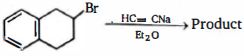
What are the products obtained from the. following reaction ?
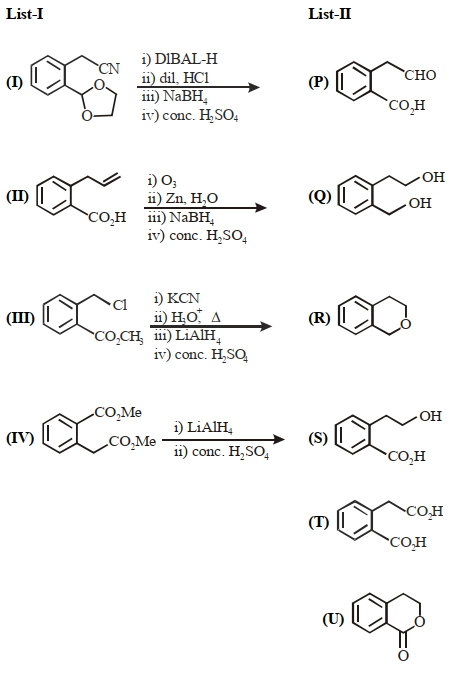
Answer the following by appropriately matching the lists based on the information given in the paragraph $List-I$ includess starting materials and reagents of selected chemical reactions. $List-II$ gives structures of compounds that may be formed as intermediate products and/or final products from the reactions of $List-I$

($1$) Which of the following options has correct combination considering $List-I$ and $List-II$?

$(1) (III), (S), (R)$ $(2) (IV), (Q), (R)$ $(3) (III), (T), (U)$ $(4) (IV), (Q), (U)$

($2$) Which of the following options has correct combination considering $List-I$ and $List-II$?

$(1) (I), (Q), (T), (U)$ $(2) (II), (P), (S), (U)$ $(3) (II), (P), (S), (T)$ $(4) (I), (S), (Q), (R)$

Give the answer quetion ($1$) and ($2$)