MCQ
Which of the following statement is /are true?
  • In metal carbonyls, $d_{C-O}$ is more as compared to that in $CO-$ molecule
  • B
    The pair of compounds $[Cr(H_2O)_6]Cl_3$ and $[CrCl_3(H_2O)_3] 3H_2O$ show hydrate isomerism
  • C
    $d_z^2$ orbital of central metal atom/ion is used in $dsp^2$ hybridisation
  • D
    Facial and meridional isomers are associated with $[Ma_3b_3]^{n±}$ type complex and are optically active

Answer

Correct option: A.
In metal carbonyls, $d_{C-O}$ is more as compared to that in $CO-$ molecule
a

Need a full question paper?

Generate a complete, print-ready paper with questions like this in minutes — across 16+ boards, with answer keys.

Start Generating Free

Similar questions

${N_2}$ and ${O_2}$ are converted into monocations $N_2^ + $ and $O_2^ + $ respectively. Which is wrong
Arrange leaving power of $Nu^r$ group in decreasing order

$(I)$ $\begin{array}{*{20}{c}}
  {O\,\,\,\,\,\,\,\,\,\,\,\,\,\,\,\,\,\,\,\,} \\ 
  {||\,\,\,\,\,\,\,\,\,\,\,\,\,\,\,\,\,\,\,\,\,} \\ 
  {O - S - {C_6}{H_4} - C{H_3}} \\ 
  {||\,\,\,\,\,\,\,\,\,\,\,\,\,\,\,\,\,\,\,\,\,\,} \\ 
  {O\,\,\,\,\,\,\,\,\,\,\,\,\,\,\,\,\,\,\,\,\,\,} 
\end{array}\,$   $(II)$ $\begin{array}{*{20}{c}}  {O\,\,\,\,\,\,\,} \\   {||\,\,\,\,\,\,\,} \\   {O - S - {C_6}{H_5}} \\   {||\,\,\,\,\,\,\,} \\   {O\,\,\,\,\,\,\,} \end{array}\,$$(III)$ $N_3$ $(IV)$ $Br$

Product of the reaction is
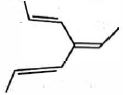
How many geometrical isomers are possible for the above compound ?
How many of the transformation given below would result in aromatic amines?
In the reaction ${I_2} + {I^ - } \to \,{I_3}^ - ,$ the Lewis base is
Which of the following carbohydrates is a disaccharide
The following acids have been arranged in the order of decreasing acid strength. Identify the correct order.

$(I)$ $ClOH$ $(II)$ $BrOH$ $(III)$ $IOH$

$STATEMENT-1$: $\left[\mathrm{Fe}\left(\mathrm{H}_2 \mathrm{O}\right)_5 \mathrm{NO}\right] \mathrm{SO}_4$ is paramagnetic. and

$STATEMENT-2$: The $\mathrm{Fe}$ in $\left[\mathrm{Fe}\left(\mathrm{H}_2 \mathrm{O}\right)_5 \mathrm{NO}_3 \mathrm{SO}_4\right.$ has three unpaired electrons.

Consider the complete combustion of butane, the amount of butane utilized to produce $72.0\, \mathrm{~g}$ of water is $....\,\times 10^{-1}\, \mathrm{~g} .$ (in nearest integer)