MCQ
Which of the following statement is correct
  • A
    A good absorber is a bad emitter
  • B
    Every body absorbs and emits radiations at every temperature
  • C
    The energy of radiations emitted from a black body is same for all wavelengths
  • The law showing the relation of temperatures with the wavelength of maximum emission from an ideal black body is Plank’s law
Answer

Correct option: D.
The law showing the relation of temperatures with the wavelength of maximum emission from an ideal black body is Plank’s law
d
(d) A good absorber is a good emitter hence option $(a)$ is wrong. Every body stops absorbing and emitting radiation at $0\,K$ hence option $(b)$ is wrong.

The energy of radiation emitted from a black body is not same for all wavelength hence option $(c)$ is wrong.

Plank’s law relates the wavelength ($\lambda$) and temperature $(T)$ according to the relation

${E_\lambda }{d_\lambda } = \frac{{8\pi \,hc}}{{{\lambda ^5}}}\frac{1}{{[{e^{hc/kT}} - 1]}}{d_\lambda }$. Hence option $(d)$ is correct.

Need a full question paper?

Generate a complete, print-ready paper with questions like this in minutes — across 16+ boards, with answer keys.

Start Generating Free

Similar questions

What is the ratio of specific heats for a diatomic gas?
A ball is projected upwards from the top of a tower with a velocity of $50\, ms^{-1}$  making an angle of $30^o$ with the horizontal. The height of the tower is $70\, m$. After how  many seconds from the instant of throwing will the ball reach the ground ?.......$s$
The centre of mass of a system of particles is at the origin. It follows that:
Pascal is the unit of:
By stretching the rubber strings of a catapult we store $..........$ energy in it.
An air bubble of radius $0 .1\, cm$ is in a liquid having surface tension $0.06\, N/m$ and density $10^3\, kg/m^3$. The pressure inside the bubble is $1100\, Nm^{-2}$ greater than the atmospheric pressure. At ....... $m$ depth is the bubble below the surface of the liquid ? $(g\, = 9.8\, ms^{- 2})$
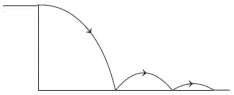
A ball is thrown horizontally from a height with a certain initial velocity at time $t=0$. The ball bounces repeatedly from the ground with the coefficient of restitution less than $1$ as shown below. Neglecting air resistance and taking the upward direction as positive, which figure qualitatively depicts the vertical component of the ball's velocity $v_y$ as a function of time $t$ ?
The moment of inertia of a solid sphere, about an axis parallel to its diameter and at a distance of $x$ from it, is $I(x)$. Which one of the graphs represents the variation of $I(x)$ with $x$ correctly?
A $500 \,kg$ horse pulls a cart of mass $1500\, kg $ along a level road with an acceleration of $1\,m{s^{ - 2}}$. If the coefficient of sliding friction is $0.2$, then the force exerted by the horse in forward direction is ......... $N$
The $K.E.$ and $P.E.$ of a particle executing $SHM$ with amplitude $A$ will be equal when its displacement is-