MCQ
Which of the following statement is not true regarding Einsteins mass energy relation?
  • A
    Mass disappears to reappear as energy.
  • B
    Energy disappears to reappear as mass.
  • C
    Mass and energy are two different forms of the same entity.
  • Mass and energy can never be related to each other.

Answer

Correct option: D.
Mass and energy can never be related to each other.

Need a full question paper?

Generate a complete, print-ready paper with questions like this in minutes — across 16+ boards, with answer keys.

Start Generating Free

Similar questions

The $\beta$-decay process, discovered around $1900$ , is basically the decay of a neutron ( $n$ ), In the laboratory, a proton ( $p$ ) and an electron ( $e ^{-}$) are observed as the decay products of the neutron. therefore, considering the decay of a neutron as a tro-body dcay process, it was predicted theoretically that thekinetic energy of the electron should be a constant. But experimentally, it was observed that the electron kinetic energy has a continuous spectrum. Considering a three-body decay process, i.e. $n \rightarrow p+ e ^{-}+\bar{v}_{ e }$, around $1930,$ Pauli explained the observed electron energy spectrum. Assuming the anti-neutrino $\left(\bar{v}_{ e }\right)$ to be massless and possessing negligible energy, and neutron to be at rest, momentum and energy conservation principles are applied. From this calculation, the maximum kinetic energy of the lectron is $0.8 \times 10^6 eV$. The kinetic energy carried by the proton is only the recoil energy.

$1.$ What is the maximum energy of the anti-neutrino?

$(A)$ Zero

$(B)$ Much less than $0.8 \times 10^6 \ eV$

$(C)$ Nearly $0.8 \times 10^6 \ eV$

$(D)$ Much larger than $0.8 \times 10^6 \ eV$

$2.$ If the anti-neutrino had a mass of $3 eV / c ^2$ (where $c$ is the speed of light) instead of zero mass, what should be the range of the kinetic energy, $K$, of the electron?

$(A)$ $0 \leq K \leq 0.8 \times 10^6 \ eV$

$(B)$ $3.0 eV \leq K \leq 0.8 \times 10^6 \ eV$

$(C)$ $3.0 eV \leq K < 0.8 \times 10^6 \ eV$

$(D)$ $0 \leq K < 0.8 \times 10^6 \ eV$

Give the answer question $1$ and $2.$
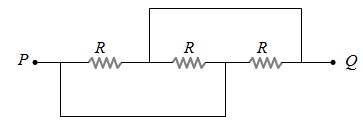
The equivalent resistance between the points P and Q of the circuit given is
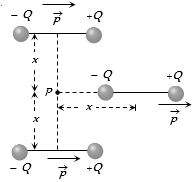
Three identical dipoles are arranged as shown below. What will be the net electric field at $P$ $\left( {k = \frac{1}{{4\pi {\varepsilon _0}}}} \right)$
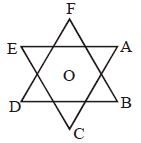
The magnitude of electric force on $2\, \mu \,C$ charge placed at the centre $O$ of two  equilateral triangles each of side $10 \,cm$, as shown in figure is $P$. If charge $A, B, C, D, E$ and $F$ are $2\, \mu \,C, 2\, \mu \,C, 2\, \mu \,C,-2\, \mu \,C, -2\, \mu \,C, -2\, \mu \,C$   respectively, then $P$ is :.....$N$
Water is flowing through a long horizontal tube. Let $P_A$ and $P_B$ be the pressures at two points $A$ and $B$ of the tube:
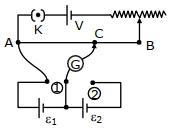
In the given potentiometer circuit arrangement, the balancing length ${AC}$ is measured to be $250$ ${cm}$. When the galvanometer connection is shifted from point $(1)$ to point $(2)$ in the given diagram, the balancing length becomes $400\, {cm}$. The ratio of the emf of two cells, $\frac{\varepsilon_{1}}{\varepsilon_{2}}$ is -
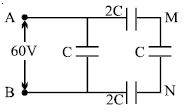
In the circuit shown, a potential difference of $60\,V$ is applied across $AB$. The potential difference between the point $M$ and $N$ is.....$V$
Two free parallel wires carrying currents in the opposite directions:
Equipotential surface is:
Assuming the nitrogen molecule is moving with $r.m.s.$ velocity at $400\, K$, the de$-$Broglie wavelength of nitrogen molecule is close to$......\mathring {A}$

(Given : nitrogen molecule weight :

$4.64 \times 10^{-26}\, kg ,$ Boltzman constant :

$1.38 \times 10^{-23}\, J / K ,$ Planck constant :

$\left.6.63 \times 10^{-34}\, J . s \right)$