MCQ
Which of the following statement is true
  • Absolute zero degree temperature is not zero energy temperature
  • B
    Two different gases at the same temperature pressure have equal root mean square velocities
  • C
    The root mean square speed of the molecules of different ideal gases, maintained at the same temperature are the same
  • D
    Given sample of $1\, cc$ of hydrogen and $1\, cc$ of oxygen both at $NTP;$ oxygen sample has a large number of molecules
Answer

Correct option: A.
Absolute zero degree temperature is not zero energy temperature
a
$(A)$ $\rightarrow K \cdot E$ is given by $\left(K \cdot E=\frac{3}{2} \cdot K_B \cdot T\right)$. If. $T$ is zero, then $K E$ will be zero. But the Potential Energy still remains It may or maynot be zero. Thus, Absolulé zero temperature is not zero energy temp. option $A$ is correct.

$(B)$ $\rightarrow$ R.Ms. velocity $=\sqrt{\frac{3 R T}{M}}$, So it depends on Mass olso. So two different gases will have different R.M.S velocities. So option $B$ is incorrect.

$(C)$ $\rightarrow$ Similar as above option B. R.M.S depends on molar mass also. So. option $C$ is ircorrect.

$(D)$ $\rightarrow$ No. of molecules $=\frac{\text { mass }}{\text { molar mass }}$ So, no. of molecules is inversely paportional to molar mass. The molar mass of oxygen molecules are more, so No. of molecules of oxygen will be less. option. $D$ is incorrect.

Need a full question paper?

Generate a complete, print-ready paper with questions like this in minutes — across 16+ boards, with answer keys.

Start Generating Free

Similar questions

A radioactive sample consists of two distinct species having equal number of atoms $N_0$ initially. The mean-life of one species is $\tau $ and of the other is $5\tau $. The decay products in both cases is stable. The total number of radioactive nuclei at $t = 5\tau $ is
The $n$-side of the depletion layer of a $p-n$ junction
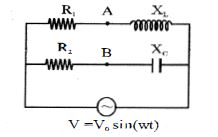
In a parallel $AC$ circuit with $R_1 = R_1 = R$ and $X_L = X_C = X$ . An $AC$ source is connected across the circuit as shown in figure. The $RMS$ value of potential difference $V_A - V_B$ will be
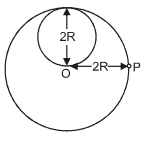
A lamina is made by removing a small disc of diameter $2 \ R$ from a bigger disc of uniform mass density and radius $2 \ R$, as shown in the figure. The moment of inertia of this lamina about axes passing through $O$ and $P$ is $I _0$ and $I _{ p }$, respectively. Both these axes are perpendicular to the plane of the lamina. The ratio $\frac{ I _{ P }}{ I _0}$ to the nearest integer is:
A buggy of mass $100\, kg$ is free to move on a frictionless horizontal track. Two men, each of mass $50\, kg$, are standing on the buggy, which is initially stationary. The men jump off the buggy with velocity $=10m/s$ relative to the buggy. In one situation, the men jump one after the other. In another situation, the men jump simultaneously. What is the ratio of the recoil velocities of the buggy in two cases?
If $|\vec A \times \vec B| = \sqrt 3 \vec A.\vec B,$ then the value of$|\vec A + \vec B|$ is
A body has $-\, 80$ $micro\, coulomb$ of charge. Number of additional electrons in it will be
In a thermodynamic process pressure of a fixed mass of a gas is changed in such a manner that the gas releases $30$ joules of heat and $10$ joules of work was done on the gas. If the initial internal energy of the gas was $30$ joules, then the final internal energy will be ........ $J$
The stopping potential $({V_0})$
An automobile engine develops $100\ kW$ when rotating at a speed of $1800\ rev/min$.  What torque does it deliver .......... $N-m$